
|
title: Put the knife down and take a green herb, dude. |
descrip: One feller's views on the state of everyday computer science & its application (and now, OTHER STUFF) who isn't rich enough to shell out for www.myfreakinfirst-andlast-name.com Using 89% of the same design the blog had in 2001. |
||||||
|
FOR ENTERTAINMENT PURPOSES ONLY!!!
Back-up your data and, when you bike, always wear white. As an Amazon Associate, I earn from qualifying purchases. Affiliate links in green. |
|||||||
x
 
MarkUpDown is the best Markdown editor for professionals on Windows 10. It includes two-pane live preview, in-app uploads to imgur for image hosting, and MultiMarkdown table support. Features you won't find anywhere else include...
You've wasted more than $15 of your time looking for a great Markdown editor. Stop looking. MarkUpDown is the app you're looking for. Learn more or head over to the 'Store now! |
|||||||
| Wednesday, November 23, 2022 | |||||||
|
From MacRumors on Apple tracking you with first-party apps:
I was of two distinct minds when I read this:
Re: 1. -- here's a screencapture from a related YouTube video: 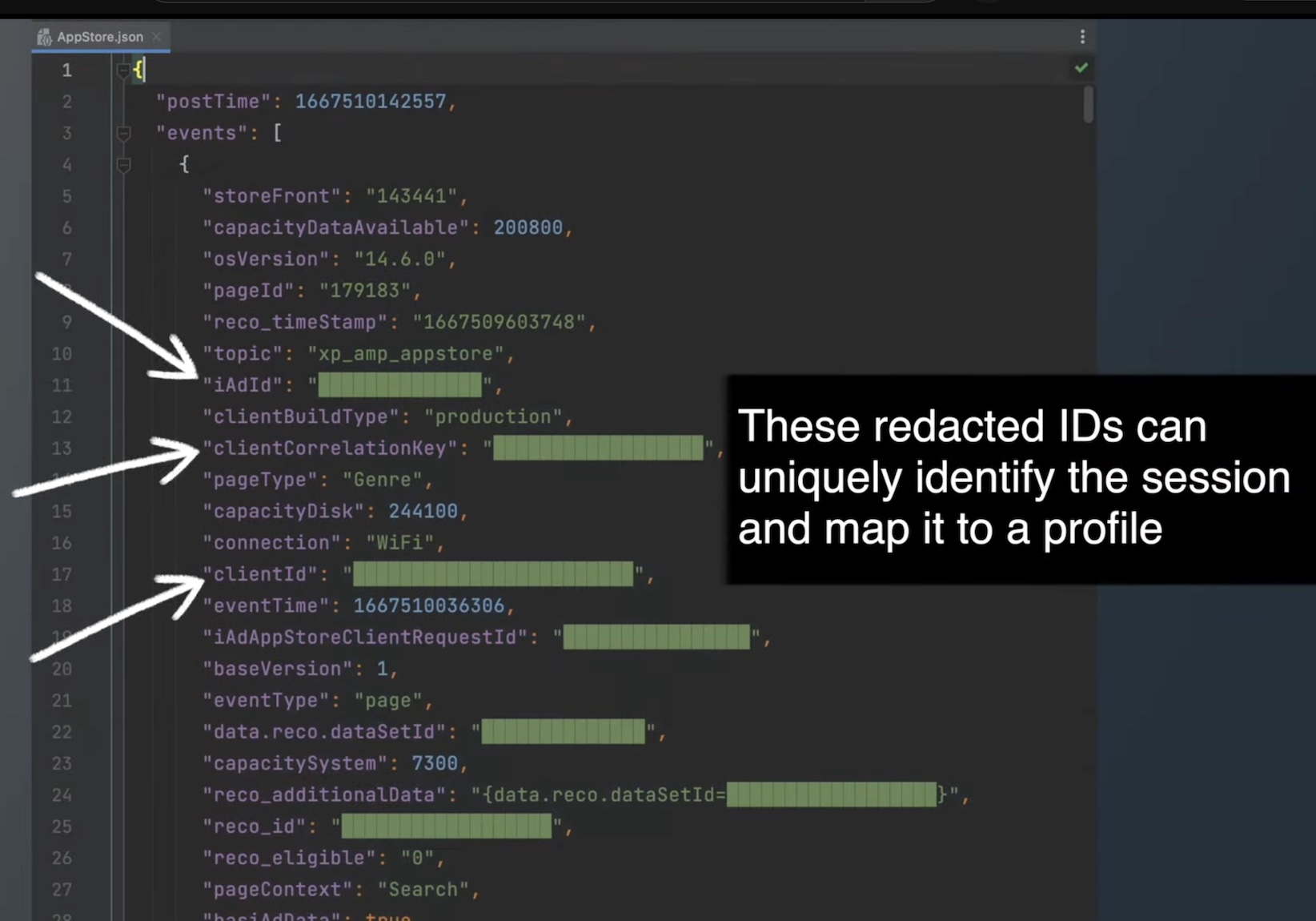 That at first seems mostly like fair game info, doesn't it? But if you say "I don't want anyone tracking me," I can understand why you don't want and, what's more, wouldn't expect all of that pushed up into the pipe. As a developer, it'd be nice if Apple had to ask for that info the same as anyone else. I wonder how much of Apple not truly dogfooding is so they can claim they can't split the software and hardware sides of the house. Because otherwise they really, really should dogfood as if they were any other app maker. Leveling the app-building playfield would improve every user's experience, because Apple could no longer take shortcuts when determining iOS' priorities. "Oh, we can just grab that data from the OS," would no longer be a strategy, and, "Hey, we lose 90% of our conversion with this modal asking for full hardware info," would be enough for iOS to make those decisions move more smoothly, however that might be. Oh, in other news, I finally got a Framework laptop. They had the 11th gen i5 refurb come back in stock for $600, and that's about what I'd pay to play around in this world. If there's a 13th gen CPU update next year that I can use, I might "really" shell out then, depending on how quickly and completely I take to Ubuntu. So far, versus my last foray into Linux on the desktop (admittedly over 10 years ago, I believe), it's nice and fast. Labels: app dev, app store, apple, dogfooding, privacy posted by ruffin at 11/23/2022 08:33:00 AM |
|||||||
| Sunday, December 27, 2020 | |||||||
|
Remember when there was at least a tacit understanding that iOS App Store screen shots showed the app itself? Then it was okay if you skirted that a little and showed a composite image of your app that spanned two demo slots, maybe with some “Now 88% more cooler!!1!” lain over top?
Now we’re not even pretending there’s decorum. Do whatever. posted by Jalindrine at 12/27/2020 10:52:00 AM |
|||||||
| Friday, October 09, 2020 | |||||||
|
Okay, the Apple forces ProtonMail to add IAP story is getting a lot of play today, but I don't see why it's anything new. From the linked article at The Verge: [ProtonMail CEO Andy] Yen says Apple’s demand came suddenly in 2018. “Out of the blue, one day they said you have to add in-app purchase to stay in the App Store,” he says. “They stumbled upon something in the app that mentioned there were paid plans, they went to the website and saw there was a subscription you could purchase, and then turned around and demanded we add IAP.” Emphasis mine. ProtonMail makes money selling email plans. They're not required, and you can get a free one. If you don't talk about a paid plan in your app, no IAP is required. If you do, Apple has pretty good precedent to require you also offer it as an IAP. You are not allowed, as I understand it, to mention the ability to buy services through another, off-app means. Look, I don't love that, but at least I get it. It's not inconsistent unless I'm missing something here. I'm also surprised by this... “When Apple charges 30 percent extra ... we don’t have a 30 percent margin! It’s very odd to find a business with 30 percent profit margins,” [Yen] explains. Come off it. You can't say that and have this on your pricing page: ProtonMail is community software, funded by the community, and open source. We do not show ads or make money by abusing your privacy. Instead, we depend on your support to keep the service running. Revenue from paid accounts is used to further develop ProtonMail and support free users such as democracy activists and dissidents who need privacy but can't necessarily afford it. 70% of a donation, so to speak, is still a donation. If you weren't going to get ANY dough from iOS users -- if they're all free tier users and the app doesn't mention other tiers -- then 70% of something is all found money. The point being these quotes are from companies who of course want Apple to charge less. This isn't a "I can't eat with this model" type principled stand, afaict. It's a PR tool to put pressure on Apple to give up some revenue. I get why they're doing it, and I don't disagree with their goal, just their methods. Which is to say that I don't think Yen is being especially straight with us here. Want to use the iOS App Store increase your range? Do it. But understand that has a cost. My sentiment in that last paragraph reminds me a little of Ballmer talking to Java (What was it, "get on our backs and ride"?) and I'm trending into Rene Ritchie level pro-Apple screed, which scares me, so I'm going to stop now. Labels: app store, apple, business, hats of money posted by ruffin at 10/09/2020 11:40:00 AM |
|||||||
| Thursday, August 16, 2018 | |||||||
|
From a reply I posted to Michael Tsai’s excellent blog, this time talking about pushback to Apple’s encouragement of SUBSCRIPTIONS FOR EVERYONE!!!!1!: I have no problems paying a bit more for quality apps, but either it’s pay upfront, or it’s highly unlikely I’ll subscribe to an app. Sorry, devs. Labels: app, app store, app store econ, business posted by ruffin at 8/16/2018 08:38:00 AM |
|||||||
| Friday, December 23, 2016 | |||||||
|
From a Windows Developer email:
You know, when you give an app store (iOS, macOS, Windows) 30% of your take, you actually tend to get a lot.
That's not bad. The question's not even, "Is that worth 30% of my revenue?" for many (most?) developers. The question is, "Is 30% too much to give up to release my app before I could have all of this other stuff ready?" If you could release at Day 0 instead of Day 250, and 70% of the lost sales from 0-250 would make up more than 30% of all sales, then you're an idiot not to release with in an app store as quickly as you can. What the store buys you is a reduction in time to market. Use that. What it also buys you is more markets. There's no way I could keep track of VATs and taxes for every country, especially when these countries don't make up much of my user base. Microsoft is big enough that it's worth it to them, as part of the 30% they take from us, to make changes like this VAT charge. Course it stinks. I'm now getting 70% * 82% = 57.4% of my list price in Russia. Ouch. I could make the price higher to cover the VAT, but for the sales I have there, I probably won't bother. As Joel says, it's all about barriers to entry. Such a protective tariff should make foreign software more expensive in Russia. I wonder to what extent it does. Labels: app dev, app store, app store econ, indie, taxes, windows store posted by ruffin at 12/23/2016 02:14:00 PM |
|||||||
| Saturday, April 09, 2016 | |||||||
|
Chris Adamson on the App economy [via Dan Counsell's weekly email]:
Much wrong. Many fix. First, if you read earlier this week, I think Pieter Omvlee was right. The Apple App Store is a dollar store.. Many indie developers don't want to sell there. Stop saying it's broken. If you don't have a dollar app, forget the App Store storefront.What I added to Omvlee's talk is that even those who don't want to sell in App Store storefront still want to be in the warehouse. You have to be if you want to sell inventory. That is, here are the things the Apple App Warehouse does not do for you, if you don't have a dollar store app:
Here's what the Apple App Warehouse does do for you:
etc etc. You're really asking for Apple to open another app store
That's really all anyone's asking for when they say, "The App Store's broken." What they mean is that, "The current store is broken for me," which is to say, "The current store isn't where I want to sell." For now, that means you have to make your own store on the web. That stinks, but would you really pay 7% of your gross to Apple to create a better store? Maybe. Maybe. If you knew you'd be featured, sure, but just because they make "Apple App Store Pro" or "Apple App Store Curated" doesn't mean you'll be in the window. Take that extra 7%, put it aside for marketing, and sell like mad. That said, Adamson has some interesting points. First, on why the Store is sufficient for Apple now:
I'd stopped listening to the Accidental Tech Podcast (ATP) after they took on Cards Against Humanity as a sponsor -- that game really is evil. It's, as I've said elsewhere, the I Ching (which is not evil) of hate speech (which is) -- but this was interesting too:
I've been realistically bearish on indies in the App Store for a while:
(That last is a little clickbaity, sure, but only in its simplisticness. It could be a lot less.) At the same time, I'd want to reframe the conversation a little, like I did when talking about attacks Jared Sinclair got for his Unread numbers. Stop thinking about working as an independent app developer as something that should pay you something comporable to a 9-to-5er cubicle coder. You could make a lot more as a banker than as tax return dude with a shingle, but you chose the latter. It's a different field. Stop seeing $20k for one app over a year (really $25k, apparently) as failure. See it as Curtis Herbert does...
Apps are investments. You sell these investments from the Apple Dollar Store or from your own storefront, your choice. They're delivered from Apple's App Warehouse. You create and maintain enough investments, and you might rival a consultant for salary. That's the profession you choose. Enjoy your time. That's its best perk of all. Labels: app dev, app store, app store econ, apple, business, indie posted by ruffin at 4/09/2016 11:00:00 AM |
|||||||
| Friday, April 08, 2016 | |||||||
|
Fixel throws down the gauntlet:
"Bucks the trend of free or next-to-free", huh? That's not just a "buck"; that's a horse rolling on top of the rider, then tossing 'em back into the air, before drop-kicking them into the middle of next week. But Fixel is an example of their own problem. There is no single app type. To say that there's a "trend of providing mobile apps for free or next-to-free" is to identify only the conditions of the dominant storefront. It's like saying that Northern Tool is bucking the trend of providing wrenches for next-to-free. The real insight, as Pieter Omvlee insightfully said at the 2015 Release Notes Conference, is that the iTunes App Store is a dollar store. The problem with the iTunes App Store for many of us is that a dollar store is also likely not your store. But no corner dollar store (when did 5 & Dimes die?) has millions on millions of items. That's a warehouse. Which tells us... The iTunes App Store is actually two stores. It's a Dollar Store. And it's a policed warehouse that stores your app "inventory".Apple allows your customers to enter the warehouse, but that doesn't guarantee your product will be on the showroom floor. The App Store is Ikea with a huge warehouse, that, um, only highlights knickknacks and cheap radios. That is, the showroom is a dollar store. Q.E.D. You have to stop thinking of the App Store as your store, and think of it in these two ways. Again,
Just expect, if you want to clear that warehouse inventory, to sell your app yourself.You don't have to target the dollar store if you're selling clothing, for instance. Don't. Don't be upset if the dollar store features your app. It's unlikely at $249.99, but if it happens, it's still good, free press. But open a storefront on the other side of the warehouse's block. Sell that inventory from your own store on the web. posted by ruffin at 4/08/2016 09:27:00 AM |
|||||||
| Wednesday, March 30, 2016 | |||||||
|
Interesting quote from the appbot blog:
I keep hearing that the ability to respond to reviews is one of the pieces that needs to be fixed in the iTunes App Store (for iOS), and I still buy that the ability to reply would be wonderful, but that's a heck of a number. Why might it be so low?
It's that last one that I wonder most about. Even the most adamant iOS indie developers probably aren't going to reply nearly as often as they believe they would. They might reply when they see something they feel is insanely unfair -- replying could be an effective way to vent, and, if composed carefully, the vent could be productive -- but I doubt it'll be used as often as folks believe. I still think it's important to be able to reply, however. When I'm eyeballing a three star app, and am about to tank the purchase, my mind could be easily swayed by a developer that's engaged and can explain why, eg, what appeared to be a bug wasn't. Simple engagement, a "proof of life", almost, would go a long ways, if the replies are carefully written. Still, 97%? Ouch. Abandonware. Speaking of abandonware... I think I started an abandonware post mortem for BlogGo a while back. Will probably do one for WorkBurst too. It seems like these two folks did everything right, yet their well-marketed apps seem to have tanked. Why? I mean, anything showing an "introductory price" nearly two years after its last update, and with only five reviews of that version, is probably D-E-D dead. The fate of these apps is both kind of sad -- and scary -- to possible app developers. I'll talk more later with abandonware post mortems, but, to tie it into today, I'm not sure either app producer would spend a lot of time replying to negative reviews today, even if they could. Still, 97%? Wow. Labels: abandonware, app dev, app store, indie posted by ruffin at 3/30/2016 10:51:00 AM |
|||||||
| Monday, February 29, 2016 | |||||||
|
No, no, I'm not nearly ready for app review. Instead, I'm relaying (via Michael Tsai) a fairly interesting post from (buried lede...) an indie development newsletter. (Aside: Have you noticed that email newsletters are picking back up some steam?)
It's an almost humorous self-prep case-study so that you know once you're done with an app, you're not done. Unless you're on the Windows App Store, or at least the old Windows Phone 8 app store, which almost immediately approved my app when it had a show-stopping bug on launch once deployed on any device but mine, which was fun. Which is to say, the Windows Phone app store reviewer didn't even open my app before approving it. Wow. Or maybe immediately crashing looked like a feature? ;^) Labels: app store, indie, review, windows phone posted by ruffin at 2/29/2016 02:13:00 PM |
|||||||
| Tuesday, August 25, 2015 | |||||||
|
A quote from a blog I'm reading a lot more regularly now, Baldur Bjarnason's:
And then a follow-up here:
I'm not sure what the angle Bjarnason's ascribing to RMS, but I bet I'll repeat it here accidentally. Look, here's the problem with OSS... Well, here's the problem with indie-garage software coders (the toymakers) in general: As RMS says, software [sic] wants to be free. That's in large part why the App Store prices raced to the smallest possible (imagine if Apple had let you set any price! How many 12¢ apps would there be?). The marginal cost of distributing software, once written, quickly approaches nil. What's neat is what you can do with software. If you make software that enables people in real time to do something interesting, you can sell that service. Software naturally enables. If your hours of github wrangling is worth 98¢ in actual cashola, but enables you (and others) to perform thousands of dollars of services, well, yes, github is your resume. That is, if you chose to write server-side code, you've already boxed yourself into a use that'll never be customer facing. The flip side is -- your faceless, nearly designless software is barely worth anything on its own. There are so many replacements for what you've done. If you charge so much as 99¢, folks will go elsewhere. It stinks, but it's the hard truth. Sellable software requires design, serious design. Otherwise you'll never hit that group of end-users willing to give you real cash (the "market"). So it's better to give your services-focused software (your jQuery plugins and SQL profilers) away for free. At least then the barrier to entry of licensing and price is gone, and you have what's at worst an even playing field with your like-minded competitors. You probably still won't build the next Bootstrap, but now you at least have a shot. Hard truth time? Even those folks that try to eek a living out of customer-facing apps, and who are good at it, have a really hard time making ends meet. And there's nothing wrong with writing code for a job. Server-side programming pays well. You will love your salary for doing brainteasers. But you're not overtly using open source to be political in this case. You're following the market's natural direction. That is, these "resume" projects you're making are likely the easiest worthless projects (insert a smilie and remember that my assertion is that all software wants to be free and is, eventually, essentially worthless) you could make. And, again, good for you. Most people never share excellent worthless work. ;^) Free Software's alternativeIf Bjarnason's point is that non-GPL licenses are too lenient, I've agreed for years. You have to use a protective license if you want to create a privileged space that competes with capitalism. You must use capitalism to create this Free haven. The most brilliant, Deluezo-Guattarian move GNU ever made was to copyleft software. Use copyright to fight copyright. Use capitalism to fight capitalism. Inhabit, reassemble, and redirect. Don't fight head-on. And it's the lack of inhabitation that's killing the dream of OSS (and GNU) idealists. Where are OSS' best wins on the client? LibreOffice, which is still a big win. Firefox, less important now that there's mobile, as Bjarnason points out. Even The Gimp or Audacity were good apps. But none of these are best in class designs. Where is the better mail client, the better word processor, the better personal finance software? Where is the better desktop OS? Where is my hoverboard? Cutting closer to the bone, how much Free software do you use "at home"? How about that phone in your pocket? Is it Free software? Look man, it's not. You're happy to use OSS at work, but you're not using it at home. How do you expect work software to make your home life better? How is Free software going to improve your life if you don't use it? Better yet, WHY AREN'T MORE OF YOU CONTRIBUTING TO REPLICANT, the truly Free Android fork? In other words... Why aren't we putting our time into game-changing software?If you want to create that idealistic society that Free software enables, you have to work on projects that society cares about. As long as Free software remains derivative, it's going to be playing catch-up. And if Free clients are only as good as paid clients from ten years ago, platform-jumping (like the one from PC to mobile) will keep catching it by surprise. Until we concentrate on the client -- that is, servicing the needs of people, dammit -- Free software will continue to gain a foothold only in those spaces where the software experience is completely fungible, like we see on servers today. It's not OSS' fault (I realize I'm conflating OSS and Free software too much) that we haven't created the ideal. It's ours. (This is where, if I allowed myself more time, I'd start into suggestions about how to make this happen. Use Free software "at home" (and in your pocket). Learn the apps' foibles. Learn the languages used to create them, or figure out how best to recreate them. Find the pain points its users would have, and make the apps truly citizen-usable. And help folks figure out how to make Replicant work. There's like one dude plying away at the most important Free software project going, and that's simply not enough.) posted by ruffin at 8/25/2015 10:06:00 AM |
|||||||
| Saturday, August 22, 2015 | |||||||
|
So M.G. Siegler goes against all sorts of conventional wisdom and says you don't want lots of users at launch. Whaaaaat?
That's directly contrary to Dan Counsell's recent advice (see here for one), and also against common sense. I understand his point: If what you release is crap, and lots of users' first impression of you is crap, you could end up with a stinky reputation that follows you forever. I'd like to see three companies that have suffered such a horrible fate as to be undone by Apple featuring them on the App Store. Look, if Siegler is seeing App Store featuring as something's that's killing businesses, I've got three pieces of advice.
I think it's that easy. If free exposure is bad, your software's horrible. Learn to QA, and stop rushing to market, you wacky, initials-only venture capitalist. ;^) * Honestly, the only way he could be getting so many users time after time that hit support so hard that it's killing businesses [to the point he doesn't want to be featured] is if they're free to download apps. Honestly, it's the *only* way. posted by ruffin at 8/22/2015 11:02:00 AM |
|||||||
| Wednesday, August 19, 2015 | |||||||
|
So Dan Counsell kicked the hornets' nest again regarding MAS upgrades.
Whoa. Any time you blame Apple, take a step back[1]. Aren't there ways to provide paid upgrades? I mean, really, is it that complicated to dream up a way to include paid upgrades using In-App Purchases (IAPs)? I understand that the MAS doesn't have a simple mechanism for making app upgrades, and is pretty clearly trying to, at least implicitly, encourage you to make software that your user buys only once and receives free upgrades forever. I understand that this isn't sustainable for indie devs, but I also know we're smart enough to work around it. The problem's solutionSo let's say I was, I don't know, writing an email client that I release just before or during 2016, and it costs you $55. It turns email from timesink to a thoughtless extension of your mind, and you can't stop yourself from clicking Buy. During 2016, I code like mad and add a host of new features. Heck, let's get crazy and say I rewrite the entire app (btw, never do that). Now I want to release EmailClient 2017 for $55 for new folks, but only $10 for you, my loyal customer. Seems easy on its face, doesn't it? I keep EmailClient on the MAS. It now has an IAP called, "Super Groovy 2017 features" that runs you $10. But, get this, if you never had the app installed, you get these features for free! Wait, what? Wacky, huh? ImplementationThe "only" problem is implementation, and yep, it's a problem[2]. But isn't that what we do? We solve coding problems. How could we do it? Well, if you have an email client, you have all sorts of methods, the most straightforward probably being to save a hash to a sandboxed folder with some user-identifying info, some salt, and the date of first use. And any app could do this reasonably safely, even without a simple web service, making the unlock of new features difficult, though obviously not impossible, to crack.[3]. Poof. We have upgrade pricing. Right? I mean, it's a little code smelly, but we have it. EDIT: I guess there's one issue -- we'll have an IAP those users don't need to buy. That's a tough call; I haven't played around with IAP on the MAS yet. Any context there? Can you hide an IAP inside of the app? Or direct folks directly to the IAP? I think the only IAP I've done is a tip for Pedometer++, and it seems like he had links to each option, which is very much like the prereq IAP stacking I mention, below. The absolute worst case here is that we have to ship two apps painfully grafted into one. I've heard horror stories (particularly from the Core Intuition folk, if my memory serves) of moving from long untouched libraries to the recent ones, keeping old versions of XCode and OS X laying around to do emergency patches, and other related issues. I'm not sure you could ship some of this obsolete stuff easily in an app that's targeting 10.11. Which brings me to the other upshot of this plan... Eventually you're going to give it away for freeMaybe not in 2017, but at some point, maybe three releases later, I'm going to give everyone what's in EmailClient 2017, and give it to them for free. That is, you don't want an IAP list that says, "EmailClient 2017 Features, $10 -- EmailClient 2018 Features $10 -- EmailClient 2019 Features $10". If they didn't upgrade in 2017 or 2018, sort of like the license crackers, are they really in your market? They paid once. Why not give them a two year-old set of features? And there are going to be times when it doesn't make sense to keep bundling together Frankenstein with the original parts. Occasionally, you might need to update EmailClient Y-1 to keep the tech stack in line with this year's EmailClient Y, but now that releasing grafted upgrades is your actual strategy, you can code defensively so that you minimize code that goes obsolete next year. Sometimes it's not going to be worth the trouble to make Y-1 play nicely with Y, and you'll be stuck. Let's just hope that, for the most part, your code from last year doesn't go obsolete within 24 months in impossible to fix ways too often.[4] I'm not sure if you can "stack" IAPs[2] -- that is, require that users have EmailClient IAP 2017 before they can see EmailClient IAP 2018. I'm guessing you can't create "prerequisite IAPs", or I would've heard of a game doing it somewhere. "Want 400 gems for $5? You can, but first you've gotta buy 100 for $10!" Or worse: "$20 to unlock 1000 gem packs for $1!" But not having IAP prerequisites isn't that bad, is it? And if things ever get so gnarly that you don't want to give something away for free, well, you have other options.
There are nearly limitless ways to approach this problem. And, again, that's what brings us to the keyboards each morning, right? Fun, clever solutions to real-world problems. I mean, heck, Overcast already figured out how to perform an end-run around trial apps. Why can't we do the same for paid upgrades? ReviewsWhich is not to say the MAS doesn't still stink for new releases. This ycombinator comment in particular pains me:
I can see that. I wonder what percentage of folks review what kinds of apps. I have no idea. I guess this just gives more weight to the lesson I hear everywhere: You have to advertise outside of the MAS to sell MAS apps. The MAS is one and only one of your storefronts (was it Liscio who built up this metaphor? He's been everywhere (#70) recently). You send trucks full of software there, but you're still responsible for convincing people they want to buy. If you count on Wal-Mart's shelf placement to sell your goods, you're not doing enough to grow your business. Which is not to say we shouldn't keep challenging Apple to make the stores better. Which was Counsell's point all along, I think. (Btw, if this is the first time you've read my blog, there's a decent, just under 110%, chance you won't want to read everything, which is pretty heavy on "notes to self" style posts. You might prefer to watch just the indie tag instead. Unless you're Sam Soffes, in which case, if you're not as laid back (in that good way) as you sound, you might take this post badly. But then you could destroy this site's beautiful design, basically unchanged since 2001, and make up for it pretty quickly.) Yes, the parenthetical in the title is supposed to remind you of Loser. [1] I think it was Charles Perry's AltConf talk that had some number like 0.01% of surveyed iOS App Store authors considered their apps financial successes. If you ask me, that's a pretty good explanation for all the abandonware. That and the fact that as the store progresses, by definition there are going to be more abandoned apps. I'm guessing there are very few resurrections. So don't get too down on the app store yet! (Perry's slide is below. Go watch his talk, and then a few more from AltConf too!)  [2] Now is as good as any to admit I'm a C# guy just starting to write for OS X. Yes, I'm using Xamarin in the hopes that makes going crossplatform much easier. That said, I've used Macs for years, and have even contributed to a few Mac sites and a [trivial] piece in the Mac Bible's 6th edition, but in many places here, I'm talking without platform-specific knowledge of what the implementation would require. [3] I've been told that a lock is designed to keep an honest [hu]man honest. I think that's fair. We're doing the same thing here, because, honestly, what percentage of crack-artists were going to pay for your app? It's not zero, but it's also not close to 100%. [4] If you find that your code is going obsolete every 18 months, you might need to reconsider your dev workflow. ;^) posted by ruffin at 8/19/2015 02:03:00 PM |
|||||||
| Sunday, July 19, 2015 | |||||||
|
Appbot's blog has some neat information on it, but I'm not always sure they pay their raw data enough careful attention when showing ways you could usefully use it. Take the most recent post, Feeling the love: Sentiment in the Top 10 Free vs Paid Apps:
Would be nice if they normalized that in the image. It's nearly useless now, as it just shows total numbers. There's no real eyeballing possible.
This one scares me a bit more -- just because the word "update" is in the review doesn't mean (though I'm not sure it isn't usually a safe assumption) the review is speaking about an update that was just released. It could very well -- and this was my first assumption for paid -- be complaining that there hasn't been a recent update to add more functionality. I can't tell how well they're checking review content before categorizing it. If it's just the word popping up, the processing here isn't worth much. A later comment plays into a similar line of thought as mine:
Ultimately, the conclusions Appbots makes from the data are pretty, well, disappointingly qualitative:
This, you didn't have to pay to know. And finally...
Pet peeve: Why can't we either give up on using "its" or use it correctly? Also, a quick, random annoyance: Why can't I set up Touch ID as my password for iTunes purchases, etc without having to set up a lock code? It's not like it's more secure to have to hit my Touch ID once to unlock the phone and then again to authorize a store purchase. I don't like to have my iPhone locked, and I don't like typing my Apple ID password in the "open" to authorize something. Would be nice to leverage the Touch ID there. posted by ruffin at 7/19/2015 05:31:00 PM |
|||||||
| Friday, May 08, 2015 | |||||||
|
Edit: Great wrap up of Redacted by Michael Tsai (who is without peer at link sniping these things). And some quotes there are as sharp or sharper than mine:
So as any good, RSS-equipped indie dev wannabe knows, Sam Soffes blogged about the release of Redacted yesterday. I've watched the video, I've seen the website. I agree with you. It wasn't a great launch, and it isn't a particularly great app. I can pixelate all I want with Skitch for free. And making black boxes on top of images? RLY? How long have we been able to Windows-R, mspaint? Heck, you can make white ones in Preview by selecting and cutting.  I bet Soffes wouldn't argue any of that. He certainly doesn't argue that it was a bum launch.
Dan Counsell would not be proud. I'm all for supporting the village toymaker, but Redacted isn't exactly hitting a pain point for me, so I doubt it's aspirin for other OS X users that heard about the app either. It's the results, stupidBut our take home today isn't that the launch wasn't great or the toy isn't particuarly novel. It's that this cruddy launch of a cruddy app DOMINATED THE APP STORE!!1!.
Let's let that do the proverbial sinking in. This barely tweeted app was #8 overall paid in the US Mac App Store. That's great! Wow, look what a blog and twitter account bags you, right? What a blog and a twitter account (and #8 top paid on US Mac App Store) bags you...
Wow. #8 in the US == 59 sales, at least on May 7th, 2015. And that bagged him $302. If he stayed #8 all year he makes $110k. (Hint: He's not going to stay #8 all year. That said, by following the new, "I'll share my numbers with you indies, and then you'll buy my app," marketing plan, he's #2 currently. Sounds like he's getting $1000 today. See what a little marketing does for you? Dan's happier now. Not happy, but happier. ;^D) Who is Sam, and what's the lesson for indies?
I like the way he quietly slid his move back to full-time employment in there, but I'm not sure that's the right reaction. This is a guy who, about a year ago, made his goal to retire a year from now, at 25. Probably not going to do that at the 9-to-5. This is also a guy who, just over seven months ago, said:
That's just sad, man. And it's pretty common, I think. I follow a recently pretty quiet blog from White Peak Software. The guy hit it fairly well at least twice, once on the Mac before iOS, and once during the iOS gold rush. And he's been working as an indie (plus contracting) for 10 years. But he talks about a goal of making $700-1500 a month on software alone at one point, and apparently isn't hitting that goal. That stinks. I'll probably blog more about this later, but the lesson seems clear: Go big or go home. Target business users somewhere, somehow in your business plan. News flash, niche seekers: You can't help but shoot for a niche, but, oxymoronically, shoot for a big one. Don't go out of your way making your ideas more niche. Simply find it. And don't expect any single marketing trick (perhaps excepting the aforementioned, "Here are my numbers; buy my app" trick) to push you into the black/green/what-have-you. And don't expect to retire at 25 if you're the village toymaker. It could happen. It shouldn't be your goal. Let me be clear: I really appreciate folks blogging about what's essentially failure. Soffes hasn't failed yet, but he was on his way if he just left Redacted on the Mac App Store pile without any more marketing. You could read what I'm doing here as a pretty hard slam. It isn't, though it's not slam-free. Redacted has to be a side project for him. That is, I don't get the feeling this was the equivalent of Sinclair working on Unread: I began work on Unread at the beginning of July 2013. I spent about six weeks on the overall design of the app, then plunged headfirst into Xcode, not coming up again for air until the following spring. I estimate that I worked sixty to eighty hours a week every week from July 2013 up until the launch of Unread for iPhone Version 1.0 in February 2014. Getting several thousand dollars from a for fun side project ain't failure, man. It doesn't mean go back to Cubeland. Though getting $300 for being #8 Top Paid in the US might be. Reminds a little of Charles Perry's fable of "Pareto Distributions and the Long Tail": Luckily, there’s a lot of money to be made in that long tail. At the top of the long tail, in position 871 on the U.S. Top Grossing list, an app still makes over $700 in revenue per day. That’s almost $260,000 per year. Even number 1,908 on the U.S. Top Grossing list makes over $100,000 per year. I sent Perry an email after that post, and he was exceptionally kind with his time and replied, in detail. He's, imo, stuck on seeing the glass half full. Fair enough. But after hearing a number of people say targeting the Mac, where people will "still pay real prices" (I think Daniel Jakut, among others, has said something to that effect, though that's where his bread is buttered already), I'm not sure if the tail on OS X's store (not including straight sales, natch) is as long, and I wonder if the iOS App Store's is as fat as we thought. I can agree strongly with Charles on one thing, though, that I believe he said on Release Notes: We need to grow the pie. Soffes' big project was supposed to be Whiskey, a Markdown editor. I'm using a great, free Markdown editor right now -- MacDown. I don't see a single must-have, Markdown editor-evolving-feature on Whiskey's feature list. He's got to get better ideas, man, or he's got to gain a larger following. Note that I didn't say more original ideas. Just plain old, solid, "invest in gold" kinds of ideas. And going back to work full-time is a sort of failure within the goals Soffes' expressed for himself. Though there's still hope: Soffes tends to fall in and out of full-time work. It'll be interesting to see what happens in a year to 18 months. Labels: app store, app store econ, apple, business, indie posted by ruffin at 5/08/2015 09:54:00 AM |
|||||||
| Friday, April 10, 2015 | |||||||
|
From the Appbot's blog, "Dissecting The App Store Top Charts":
For me, the most interesting revelation was the make-up of paid apps:
I think that's percentage by app, not any weight for cost. It's just the number of apps on the store. Still, hello telling. Notice too what's fallen essentially completely out: In free apps, Social Networking is 12% of the pie. In paid, zippo in the 3% or above. Of course, what'd be really useful would be how people buy, not what's on the shelf. There can be dozens of brands of cookies, but if 98% of folks are buying Oreos, I'm not sure I want to be in the fig newton market, if you get my meaning. I mean, it could just be that every new Objective-C homebrewer brews a game first, trying to be the next Flappy Clash Birds. posted by ruffin at 4/10/2015 02:15:00 PM |
|||||||
|
| |||||||



|
All posts can be accessed here: Just the last year o' posts: |
|||||||||||||||||||||
|
||||||||||||||||||||||

|

|

|
About Our Author