
|
title: Put the knife down and take a green herb, dude. |
descrip: One feller's views on the state of everyday computer science & its application (and now, OTHER STUFF) who isn't rich enough to shell out for www.myfreakinfirst-andlast-name.com Using 89% of the same design the blog had in 2001. |
|
FOR ENTERTAINMENT PURPOSES ONLY!!!
Back-up your data and, when you bike, always wear white. As an Amazon Associate, I earn from qualifying purchases. Affiliate links in green. |
|
x
 
MarkUpDown is the best Markdown editor for professionals on Windows 10. It includes two-pane live preview, in-app uploads to imgur for image hosting, and MultiMarkdown table support. Features you won't find anywhere else include...
You've wasted more than $15 of your time looking for a great Markdown editor. Stop looking. MarkUpDown is the app you're looking for. Learn more or head over to the 'Store now! |
|
| Wednesday, March 28, 2018 | |
|
From martinfowler.com on "Command Query Responsibility Segregation", or CQRS:
As this occurs we begin to see multiple representations of information. When users interact with the information they use various presentations of this information, each of which is a different representation... This structure of multiple layers of representation can get quite complicated, but when people do this they still resolve it down to a single conceptual representation which acts as a conceptual integration point between all the presentations. The change that CQRS introduces is to split that conceptual model into separate models for update and display, which it refers to as Command and Query respectively following the vocabulary of CommandQuerySeparation. The rationale is that for many problems, particularly in more complicated domains, having the same conceptual model for commands and queries leads to a more complex model that does neither well. I saw this acronym for the first time today in a SO question about Azure Service Fabric, and my HOT TAKE!!11! was, "Who in the world doesn't do this?" There are two main data transformations that happen in essentially all of my controller code. For GETs, I'm usually flattening a "database is truth" model into a data payload, stripped of stuff like, "LastModifiedBy" (or anything not needed by the client), but also of complex relationships with child objects. That is, when Entity Framework (or any POCO-returning library) gives me, say, an address' stateOrProvince as an entity, I usually flatten that to a The second is when I return changes to these DTOs. There, the PUT (or PATCH) command often isn't strictly RESTful either [using the database as The Source of Truth]. If I'm returning the ever-proverbial Contact with three Addresses, I don't typically call an Addresses endpoint with a PUT thrice, and then follow up with another PUT to Contacts. I'll send up a DTO that's essentially There is nothing that, in my experience, causes performance bottlenecks as quickly as folks blindly falling back on performing Commands (actions that "Change the state of a system but do not return a value") via fully hydrated ORM objects. Oh, the humanity. Treating your PUTs and PATCHes as separate models from your GETs (or at least separate models from those in your database schema) allows you to spare yourself such madness. posted by ruffin at 3/28/2018 01:51:00 PM |
|
| Monday, September 05, 2016 | |
|
I think I was reading about CommonMark when I saw this mentioned.
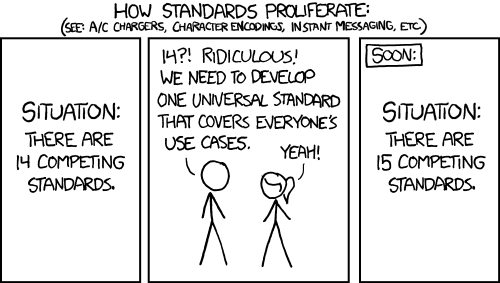
Sad because true? Honestly, I think CommonMark is probably a pretty good idea, all things considered. There are people that are going to get concerned with a "spec" that's, as CommonMark puts it, "ambiguous". You don't want strange edge cases that seem to conflict with reasonably hard and fast rules. I think the best complaint I've seen (and I can't dig the source back up in 10 mins of googling) is the "underline for headers" issue. What do you do here? Apparently the original spec didn't address many edge cases like this, and you'd have to go to the code. I can't recall why that code wasn't good enough, other than folks occasionally disagreeing with it. And different users do have different needs, so I think that's a fair complaint. And most importantly for coders, CommonMark gives you a test suite. We like to have explicit pass/fail conditions. You're only as good as your metrics and QA. But yeah, any time somebody's providing something called Babelmark to help you see what's going on in different flavors of a markup format with unresolved edge cases, you've got a fragmentation problem. Also worth mentioning: Is HTML a Humane Markup Language? from Atwood. Probably as good a visualization of why we might prefer Markdown to some other markup language that's got some traction right now as I've seen, though Atwood here (contra Atwood now, afaict) strangely decides that HTML is easier to eyeball than Markdown. In other news, I had this choice definition of POJO open from Martin Fowler's site. I was pretty confident when I read "Anemic Domain Model" that he'd meant Plain Old Java Object, but the backstory is both hilarious and tragic.
(ー_ー﹡) posted by ruffin at 9/05/2016 04:56:00 PM |
|
|
| |


|
All posts can be accessed here: Just the last year o' posts: |
|||||||||||||||||||||
|
||||||||||||||||||||||

|

|

|
About Our Author