
|
title: Put the knife down and take a green herb, dude. |
descrip: One feller's views on the state of everyday computer science & its application (and now, OTHER STUFF) who isn't rich enough to shell out for www.myfreakinfirst-andlast-name.com Using 89% of the same design the blog had in 2001. |
||||||||||
|
FOR ENTERTAINMENT PURPOSES ONLY!!!
Back-up your data and, when you bike, always wear white. As an Amazon Associate, I earn from qualifying purchases. Affiliate links in green. |
|||||||||||
x
 
MarkUpDown is the best Markdown editor for professionals on Windows 10. It includes two-pane live preview, in-app uploads to imgur for image hosting, and MultiMarkdown table support. Features you won't find anywhere else include...
You've wasted more than $15 of your time looking for a great Markdown editor. Stop looking. MarkUpDown is the app you're looking for. Learn more or head over to the 'Store now! |
|||||||||||
| Friday, December 30, 2016 | |||||||||||
|
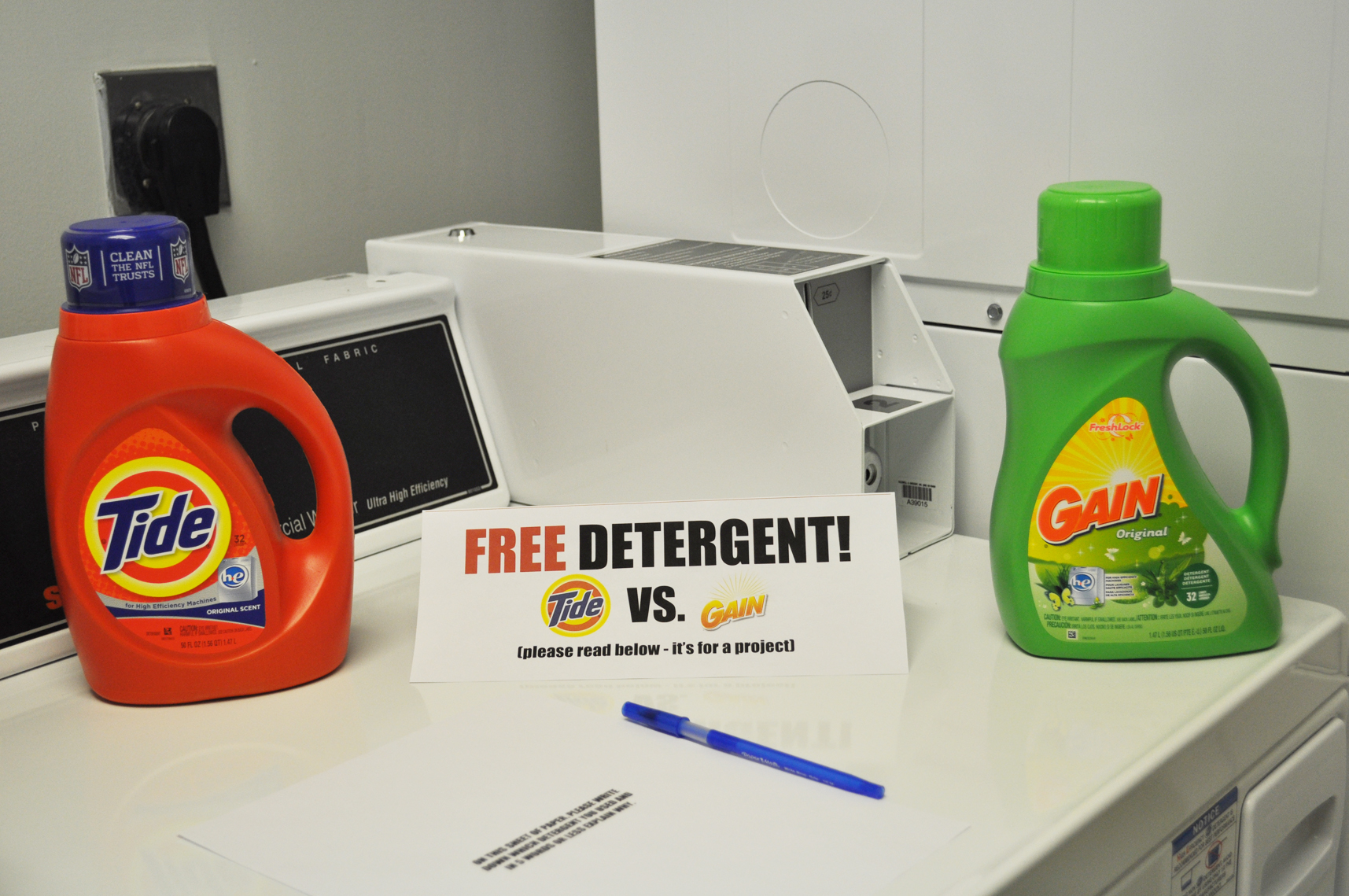
So here's a tough question: When you're creating your marketing, what do you do about competition? I'll admit, I'm not in a position where it really matters yet. Other than dabbling in AdWords, I haven't really marketed. I'm probably going to start contacting review sites and folks that have written Markdown editor comparisons soon, but telling people why my widget is better than all the other widgets of the world isn't what's holding me back from internet fame. Though part of me does wonder if that isn't part of your press kit. But at some point, isn't it a good thing to tell folks why you're better than your competition? We see that on TV all the freakin' time.
(The irony of the above image? Both Gain and Tide are Procter and Gamble products. /sigh Still, it's a clever project someone performed in their dorm -- "If you leave two free containers of detergent, which do folks pick?" This is what happens when you search for "product comparison" images "with reuse", I suppose.) Finding vs. exposing market fitOne of the things you need to do before you start making an application is to gauge product-market fit. I'll admit my fit measurement was a little spotty. I use Windows quite a bit, and was upset that the Markdown editor that I'd traditionally used hadn't been updated in months to maybe over a year when I started, and its live preview window was broken (as in no display at all) in Windows 10. But that same app had apparently sold enough units that its developer had rewritten the whole schmear at one point, hoping for even better future sales. If I could get somewhere close to what that app interpreted as "enough cash that I should rewrite what I'm already doing to make real cash", I'd be pretty happy, even if that second level cash they'd hoped for wasn't there. That is, if I could create an asset that's good enough to bring in several thousand dollars a year -- plus is easily reusable for any number of apps and extensions -- that'd worth a few months' of time, right? I did survey the state of Markdown editors before starting. It's actually, as far as I can tell, a much more crowded field on macOS. I'm not really sure why. I could guess it's because Markdown's inventor, John Gruber, runs an insanely popular Mac new blog, and there's spill-over. Or maybe having an elegant shorthand for HTML appeals to the same aesthetic as macOS. But at the same time, GitHub and StackOverflow's web interfaces both support Markdown entry, and there's nothing especially Mac-specific about either of those, even if you pretend that a disproportion number of programmers still use Macs (do they?). And every time I turned around, people publishing to the web, from readmes to blogs, were praising Markdown, releasing tutorials, and writing "Intro to Markdown" posts. If you could get anything close to a Mac-sized following for Markdown on Windows (so even a much lower percentage of total users, just with a similar total number of users) and sell to the folks that actually depend on a decent editor to get their work done, I figured you'd be doing fairly well. The state of Markdown editors on Windows is pretty sad. The one I used, as I mentioned, seems abandoned. The Windows Store is full of Markdown editors, but they're usually freeware and, honestly, bad. I've found a few crossplatform apps that are okay-ish, but don't feel like something I'd use if my publishing life depended on them. Then I found an editor that has a pretty neat website and boasts a ton of features, from tables to fully customized themes to automatic outlining. And I tried its demo. Ugly, difficult to use, poor UI, and so buggy that I felt it was unusable. Cheeky comparisonsBut how do you get the fact that your competition stinks (in many ways) across to people looking for an app? Simply be good and let people find you? That's classy, but also almost certainly doesn't maximize profit. Yet isn't it too cheeky to make a flowchart detailing what's broken?
With names, that seems like it'd be in really bad taste. But part of my selling point is that you're wasting your time just trying out these other apps. If it takes 15-30 minutes to read through a marketing site, download, install, and test out an app just to find out it's crud, that's offensive. Our most valuable asset is usually time. I'd like to think MarkUpDown is worth the money already just in the time it'll save you from searching up a competent editor. Setting a classy exampleAt the same time, look how friendly Daniel Jalkut was to John Saddington when Desk came out for macOS. From On the Shoulders of Giants – John Saddington:
I can also say that when I met John Saddington at the Release Notes conference, it became clear that post wasn't simply posturing. I asked him about the bugs I was seeing in Desk MD when posting to blogger, as I was looking to a write a similar app myself. That is, I was looking for anything -- why did he decide to ship with those bugs, what sort of reaction did he expect from users (and what was the "right" thing for me to do as a user in that situation), etc. Saddington not only took the time to explain why he had some bugs, what he felt was fair for customers like me to say ("When you're hitting that much trouble, and I know you are, ask for a refund!"), what his priority list was then in general and for Desk, but also told me, "Hey, if you do write your own, let me know. I'll totally recommend it for Blogger. Supporting Blogger drives me crazy," or something similarly as impressively helpful (I'm pretty sure John's a Wordpress user). If I'd written MarkUpDown for Mac with Blogger extensions and had started by, as he says, So I'm a little loathe to lambast anyone, if only because of the example these folks have set before me. Argh. Perhaps I should just reasonably fairly review what's out there. (I say "reasonably" just because I know I'll be a little biased towards MarkUpDown. If there's something I don't like about it, I change it. And I grossly undervalue things that don't matter to me [like most reviewers, I'd assume], like, eg, dark themes.) Then at least I can honestly say what's not working and at least rationally argue for why MarkUpDown is better. /shrug Anyhow, marketing is fun. In other news, here's an interesting list of dev podcasts in the running for some sort of award. There are a number of JavaScript 'casts. Guess I should check out more of them. Worth looking around at the others too. Labels: indie, market, marketing, markupdown posted by ruffin at 12/30/2016 06:15:00 PM |
|||||||||||
| Wednesday, March 03, 2010 | |||||||||||
|
From AppleInsider | WSJ has pre-release iPad kept 'under padlock and key' by Apple: How much to charge for content on the iPad and other devices remains a point of contention. While reports have suggested that Times executives cannot agree whether to charge $10 per month or closer to $30 per month, the Journal began charging users of its iPhone application late last year. Murdoch has previously said that News Corp. intends to charge for all of its online news sites, noting that 'quality journalism is not cheap.' A coworker once told me (luckily in a story about a third coworker) that, "A mistake on your part does not constitute an emergency on mine." Same sort of reasoning seems to apply here. That good journalism is costly doesn't make it worth more to me. Let me be blunt: I'm not paying $10 a month to access the NYT on a mobile device. I love the NYT, and consider it, on some level, to be the national register. I'd gladly pay $15 a month to receive the Sunday edition printed and delivered to my door if I was within an area with delivery. But on an iPad? Forget it. I believe newspapers are going to have to learn to recut their information. I have no idea the best way to do it. I would have thought the current advertisement driven version would have to do (and I've enjoyed the interactive Apple dual-ad advertisements in particular; not all advertisement is bad). To sum this ramble, I think it'd be smarter to figure out how to get the most money out of an ad-supported, open publication model, and then determine how much information that medium/genre/style of publication supports. I'm occasionally tempted to argue against the operation of the open market in specific situations -- there are things which the market has not yet been able to price accurately, and things for which I don't believe accurate prices can be found -- but this is a clear example of where I'm all for it. I believe the Times et al will find that Pay to Play is going to taunt them a second time. Labels: ads, control, copyright, DRM, iPad, market, news, nyt, online distribution posted by ruffin at 3/03/2010 05:50:00 PM |
|||||||||||
| Tuesday, February 16, 2010 | |||||||||||
|
This from Andrew Alexander, the Washington Post's Ombudsman, titled "Why you're seeing more copy-editing errors in The Post": Why the increased errors [in the Washington Post]? Clearly, reduced staffing plays some role. A decade ago, at its peak, The Post's newsroom had more than 900 FTES (full-time equivalent employees)... Today, the now-integrated print and online staffs total about 650 FTEs... I don't know about you, but I'm not happy to hear that journalists are writing for the computers to the exclusion of their human readers. I realize there has always been a pressure on writing to the technology. I've done a review of newspapers from the 18th century, and realize the way that length was constrained by the sheets you could afford to print and sell, or how headline lengths are influenced by column and font size, and how inserting pictures are exceptionally difficult. I've seen papers run out of a font and start printing in, eg, italics to finish up a page to save time. I know that content is influenced by technology directly. Still, what the Washington Post is doing marks a significant change for the press. Now, people are writing content for, say, Google News rather than to point out the most newsworthy events of the day. Like a gamer figuring out the secrets of the algorithm for Mike Tyson's Punch Out ("When he makes the noise, dodge right, and then upppercut"), newspaper reporters, the front line folk, are being asked to learn, anticipate, and integrate the algorithms of the news search engines ("When we're talking about someone in the movies, try to tie Angelina Jolie in there somehow" or "Make sure 'failed Obamacare' is in the title of three of today's stories somehow"). I've noticed the WaPo's declining editorial attention. To redefine what "editing" meanings is to take the lazy fellow's way out. What's happening isn't that you're doing a more complicated job. It's that you're no longer doing your old job. We're more worried about hits than grammar. And what bothers me the most is the degree to which an American institution is pushing onto the front ranks of the free press the onus for making our news match whatever Google's programmers feel is newsworthy. In the briefest terms, then, I'm exceptionally disappointed that Google's programmers have become the editors of the Washington Post. Labels: acad, business, cheating, control, digital, ethics, evil, Google, market, politics, pseudo-academic posted by ruffin at 2/16/2010 09:50:00 AM |
|||||||||||
| Monday, August 25, 2008 | |||||||||||
|
From UNC's student newspaper: Google has created a new program specifically designed for college students. The education edition of Google Apps includes e-mail service in addition to applications like Google Calendar and Google Talk, an instant messaging service. Well, why Google is interested in providing the service for the university makes perfect sense -- most will likely use Google's own web application to interface with email, and that means lots of ad revenue. And I suppose as long as you can use POP3 or IMAP to view your Google-hosted mail, I shouldn't complain. Still, what are the chances that Google stands to net more than $400k a year from your students? That is, could the university not invest in making its own, ad supported online interface and come out ahead in the long run? I would prefer that capitalism kept its sorry grubby hands away from academia, even if the university made the cash -- as if a capitalistic state institution of higher learning were still an option. Labels: acad, business, email, ethics, gmail, Google, market posted by ruffin at 8/25/2008 02:03:00 PM |
|||||||||||
| Saturday, May 24, 2008 | |||||||||||
|
I've been a little neglectful keeping on top of Java 6, but my recent trip to the Java Tutorial, which has in my experience been one of the best "how to" programming sites on the net, shows me that the marketing guys have infiltrated this once idealistically perfect site. Here's what I saw. How to Use Text Areas (The Java™ Tutorials > Creating a GUI with JFC/Swing > Using Swing Components): The TextAreaDemo example introduces an editable text area with a special feature — a word completion function. As the user types in words, the program suggests hints to complete the word whenever the program's vocabulary contains a word that starts with what has been typed. That's exactly what I needed. I'd been looking at some solutions with more functionality, where you start typing a word and a number of possibilities appears in some sort of select-list below, including the Netbeans editor and a few examples from weblogs. Each was more overhead than I wanted, and just short of writing some simplistic autocomplete code, I stumbled over this. So where's the marketing? How about the stuff that's Java 6 only, like the incredible overkill of the Java 6 only GroupLayout? Sure, you can add GroupLayout to your 1.5 and possibly 1.4 application, but why do I need this for a form with a single label and single text area? Let's look at the code. Here's the layout jive necessary with GroupLayout. GroupLayout layout = new GroupLayout(getContentPane()); Now here's what I need to get the same form, give or take, with layout code that'll work with every version of Java since Swing was released as an add-on jar. (Why bother? Mac OS X 10.4 has Java 1.5, not 6, and no GroupLayout by default. Sounds like a decent reason to me.) BorderLayout layout = new BorderLayout(); That's right, the code becomes more readable and compatible. Mr Pibb + Red Vines = Crazy Delicious! Maybe I'm an old-school idealist, but I don't believe in including a single extra line of code, much less a major code concept, in a tutorial than is absolutely necessary. Tutorial code should be designed to be written by hand, and should encourage its users to make small changes to see how those changes influence what happens. With GroupLayout, it's very difficult to add another few GUI widgets, difficult enough that the Tutorial itself tells us so on its page regarding how to use GroupLayout. Don't miss the Netbeans pimp in the following quote. Note: This lesson covers writing layout code by hand, which can be challenging. If you are not interested in learning all the details of layout management, you might prefer to use the GroupLayout layout manager combined with a builder tool to lay out your GUI. One such builder tool is the NetBeans IDE. Otherwise, if you want to code by hand and do not want to use GroupLayout, then GridBagLayout is recommended as the next most flexible and powerful layout manager. That last sentence is particularly bad marketing speak. See how they ignore the fact that saying "if you want to code by hand" is a superset of "do not want to use GroupLayout," the latter left in solely to deaden the [admittedly small] shock of what they just told you -- GroupLayout is for IDEs, not text editors. And the pseudo-objective tone of "One such builder tool is the NetBeans IDE," is borderline obnoxious. For older school programmers, that paragraph would read, "GroupLayout was created to help support GUI RAD in Netbeans, and works best in concert with that IDE. GridBagLayout is the most flexible and powerful layout manager created with hand-coding GUIs in mind." Alternately, for even older school folk, the text would be, "GroupLayout is not for hand-coded GUIs. Use GridBagLayout or BorderLayout instead." And a comment in the TextAreaDemo example saying, "This code intended for use in Netbeans," or something similar explaining why the horribly unwieldy layout manager was used, if it has to be there, would have been nice. Tutorials should present simplest case information that allow an informed programmer to learn a new trick in a simplest case, clean room environment, and then have the tools to figure out how to best integrate that into his or her work flow and environment. Pimping a specific Java IDE has absolutely nothing -- no, I hear your argument, and trust me. They have nothing to do with one another -- to do with learning to use JTextArea. Learning how to introduce JTextAreas using Netbeans is Netbeans' business. Doing it in Eclipse is Eclipse's business, etc. I don't care to see the IDE wars inserted into my tutorials. It's painful to see that Sun now prefers the opposite. posted by ruffin at 5/24/2008 10:47:00 PM |
|||||||||||
| Monday, March 24, 2008 | |||||||||||
|
From Apple Said to Weigh Unlimited Music Deal - Forbes.com: Apple Inc. is mulling a plan to upend its iTunes business by giving people unlimited free access to the music library if they're willing to pay more for the iPod and iPhone devices they use for playing and storing the digital media, according to a report published Wednesday. Well, Apple's shares are up again. If this jive goes through, I imagine they'll jump again. I mean, what do you do to get people to buy another iPod if everyone's already got two? You bundle them with unlimited music. This is a good short-term idea, but potentially horrible long-term. As the Forbes piece also said, "Some analysts said the iTunes store is too valuable to Apple for it to give away the music in it." So if it happens, I'm betting it's a bundle with new iPod purchases, so BOOM goes the sales numbers that crushed the stock a few months back, and they're sold with a pretty hefty surcharge. And I bet there's some sort of sunset on the access, if only in the anticipated life of the 'pod, which is pretty well known at this point. Why horrible long-term? What do you sell the multiple iPod owner who already has unlimited access to the iTunes music store? Oh yeah, movies. posted by ruffin at 3/24/2008 09:46:00 PM |
|||||||||||
|
| |||||||||||

|
All posts can be accessed here: Just the last year o' posts: |
|||||||||||||||||||||
|
||||||||||||||||||||||

|

|

|
About Our Author