
|
title: Put the knife down and take a green herb, dude. |
descrip: One feller's views on the state of everyday computer science & its application (and now, OTHER STUFF) who isn't rich enough to shell out for www.myfreakinfirst-andlast-name.com Using 89% of the same design the blog had in 2001. |
|||||||||||||||
|
FOR ENTERTAINMENT PURPOSES ONLY!!!
Back-up your data and, when you bike, always wear white. As an Amazon Associate, I earn from qualifying purchases. Affiliate links in green. |
||||||||||||||||
x
 
MarkUpDown is the best Markdown editor for professionals on Windows 10. It includes two-pane live preview, in-app uploads to imgur for image hosting, and MultiMarkdown table support. Features you won't find anywhere else include...
You've wasted more than $15 of your time looking for a great Markdown editor. Stop looking. MarkUpDown is the app you're looking for. Learn more or head over to the 'Store now! |
||||||||||||||||
| Monday, April 17, 2023 | ||||||||||||||||
|
You know what stinks? Sites like the Washington Times that throw so many advertisements into your face that you'll never actually get the information you want. You know what would rule? Being able to have a personal killfile for URLs that stink when you go to a search site. You can do this now on a search-by-search basis. Try this: https://www.google.com/search?q=nationals+barry+svrluga Now try this: https://www.google.com/search?q=nationals+barry+svrluga+-site%3Awashingtonpost.com Very different results. If we had enough people stop using, idk, geeksforgeeks.com (which just asked me to sign in and turn off my adblocker about four times, and not all at once, by which I mean I scroll and it asks again, and I read a while and it asks again; ARGH!!1!) or w3schools.com (which I often get in results when I want MDN... yes, I normally search with MDN in the terms now), maybe Google would learn not to include these things as high in the search rankings. Just an idea. Guess I should write a browser extension. posted by ruffin at 4/17/2023 11:09:00 AM |
||||||||||||||||
| Monday, October 31, 2022 | ||||||||||||||||
|
Amazingly (or perhaps not), Firefox (macOS 106.0.1 (64-bit)) slammed me back to using Google as its toolbar search engine. I had been using DuckDuckGo for years. Luckily Firefox had a pop-up telling me as much, actually bragging about it, so I knew to set it back. But I did test it once before swapping, and this was not a drill. The update to Firefox wasn't showing me the wrong dialog; it had slammed me back to Google. /sigh Profiteering weirds the internet. Labels: firefox, Google, hats o' money posted by ruffin at 10/31/2022 09:09:00 AM |
||||||||||||||||
| Monday, January 10, 2022 | ||||||||||||||||
|
From The Verge: "Google says Apple ‘should not benefit from bullying’ created by iMessage lock-in."
"Wow, that's rich." -Firefox posted by ruffin at 1/10/2022 09:00:00 PM |
||||||||||||||||
| Wednesday, September 29, 2021 | ||||||||||||||||
|
Remember in April when I complained about how hard Apple is selling me services, and how it made it sound like I would lose email? Guess who else is selling me services? You got it. Google. Well, specifically Gmail.  That look familiar? 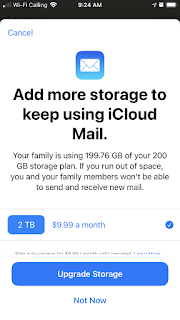 But Google allows me to "learn more" with the weird hamburger straw menu.  Let's give that a shot.  Wait, okay, that's actually kind of helpful! has:attachment larger:10M is a neat search suggestion to get rid of some oversized emails. Unfortunately I only have 125 that match. That's not nothing -- 125 at even just 10 megs each is well over a gigabyte, giving me nearly 8% of my 15 gigs of free space back and hopefully silencing this message for a while. But what really hits me is the coincidence that Apple and Google are both yelling at me to pay something [or pay more in Apple's case] at the same time. Interestingly, Outlook seems to hard cap at 50 gigs even when you're paying $70 a year (includes 1 tb OneDrive). Google offers 100 gigs in gmail for $20 a year. Apple lets you lump email in with your iCloud, so potentially 2 terabytes (!??!), but that's shared with your iCloud backups, messages, and pictures, and runs $10 a month, so... Fastmail charges $5 a month for 30 gigs and $9 for 100, which seems to be obviously too much until you recall they aren't profiting on what's in your emails. Regardless, what getting caught on both ends with "upgrade now!!1!" adverts tells me is that companies aren't scaling storage over time, as it becomes cheaper for them. And storage isn't being updated year over year because having people run out of storage is a profit center. Not crazy, but not coincidental either. This is a decided, "let's all charge for services" play by all the companies. There's money in them thar hills. Labels: apple, cloud, gmail, Google, hats o' money, icloud, outlook posted by ruffin at 9/29/2021 12:11:00 PM |
||||||||||||||||
| Monday, March 22, 2021 | ||||||||||||||||
|
With all this autocomplete in Gmail and Outlook, do you suspect it's mining my composition to suggest completions for me? For others? If I tab, is that a training point?  (That one's pretty innocuous, but I complained in Outlook that the suggestions were so long it was slowing me down... I was composing as I typed and reading through the suggestions to see if they were better. They weren't. They only wasted my time.) I mean, of course they're stealing our labor, right? Even though I'm just a coder, my English degree doesn't appreciate what this blog called [in this case talking about captchas and Street View ids for Google]... ... yet another ruse devised by Google to make you train their robots for free I recently bought a domain for personal email and was going to try it out with Fastmail as the host. This kinda pushes up the timetable on that experiment [he said as he typed into his Google-hosted blog]. Edit: This one's a little better example of robo-suggesting (and is actually what I was going to write), though still not nearly as bad as what I got in Outlook, which was nearly writing my email itself.  Labels: ai, Google, hats o' money, labor, outlook posted by ruffin at 3/22/2021 09:31:00 AM |
||||||||||||||||
| Tuesday, February 04, 2020 | ||||||||||||||||
|
Noticed something called
I'm not quite yet ready to delete it, but it's interesting to learn where this stuff lives. Labels: chrome, Google, macOS, noteToSelf posted by ruffin at 2/04/2020 11:42:00 AM |
||||||||||||||||
| Thursday, March 01, 2018 | ||||||||||||||||
|
Oh google. Your raw source makes me something something.
Why is this in the page itself? Why do you need so much source to display your page? What ever happened to humans writing html code? I know I sound like an assembly programmer in the land of OO, but it still makes me sad. ;^) Labels: cyborg, Google, human, javascript, sad, transpilation posted by ruffin at 3/01/2018 07:39:00 PM |
||||||||||||||||
| Thursday, November 09, 2017 | ||||||||||||||||
|
From ShipIt Days | Atlassian:
That's, um, nothing like 20% time. Though, of course, 20% time was never 20% time either:
That said, I think I'd take 10% time:
Interesting final quote from Bock: "[The informal 20% time policy] operates somewhat outside the lines of formal management oversight, and always will, because the most talented and creative people can't be forced to work." The interesting lesson is that you win when you convince your employee to produce more work. Maybe 20% time isn't such a bad idea for either side of the management fence. X hours of required work versus 1.2X of work the employee actively wants to give. Sounds like a win-win. Labels: business, culture, Google, management, time posted by ruffin at 11/09/2017 10:46:00 AM |
||||||||||||||||
| Wednesday, January 04, 2017 | ||||||||||||||||
|
Today, I ran across a clickbaitily titled post called Just Say No to More End-to-End Tests posted at the Google Testing Blog, written back on April 22, 2015, detailing a fictional end-to-end (e2e) testing run. The scenario was very clearly fictionalized, but you can forgive most of it, as they're simply trying to illustrate a few points. Here's their "analysis" of the test, which apparently took over a week to complete and had some serious errors with the testing apparatus as well.
The author uses this cluster of an e2e test to argue for a preponderance of unit and integration tests...
That's a lot of info to digest. Here's the problem: "Simulates a Real User" isn't a single point. Their chart really isn't a scorecard, though that's how it's presented. My quick list of critiques:
Look, more typical situations in my experience are that you either have lip-service unit tests [only] or that you have no testing at all. Guess what's most valuable if you have to pull teeth to convince management that testing is important? In my experience, it's an "end to end" test. You'll get the most return on your testing resource dollar with smoke tests. I do like to call it a smoke test, and I've had pretty good results using Selenium to automate a browser using C#. Which browser? Well, you get your biggest bang for the buck by just using one. It'd be great to test in IE, Firefox, Edge, Chrome, and even macOS & iOS Safari, but each time is a diminishing return. The first test in whatever browser is going to catch 75% of what's wrong. I recommend using either 1.) The lowest common denominator for browser functionality, usually IE, or 2.) Whatever's the easiest to get to behave for your tests. Timing can be a pain in Selenium. Recently, I've used Selenium's Chrome web driver. That's dangerous. Chrome seems the most fault tolerant of the browsers, and on a developer's phat box, you can add slow downs to browser incompatibilities as problems that are often hard to notice. But one browser, going through an automated master set of user stories, will quickly ensure that the 80% of your website that's your real bread and butter works and wasn't screwed up by whatever whizbang gizmo your latest release just pushed out the door. If there is an error, sure, it can be hard to immediately identify the exact cause, which the Testing Blog seems to think is the end of the world. And perhaps a unit test to cover each error you do discover and track down will be useful. Do that. But, again, unless you're doing TDD, to ask developers to write useful unit tests ahead of time almost never covers what your users are actually going to do and doesn't prevent bugs your own developers and QA are going to catch anyway. To get useful unit tests, you're going to have to spend even more time getting developers to code review others' unit tests, and you barely had time to green light unit tests to begin with. (How do I know that? If you had plenty of time, you'd be using TDD.) And if you've gotten so far down the line that you can't tell if an error is coming from the front or back end, as in the Testing Blog's worst-case scenario, well, you have worse problems. My suggestion if you're losing days looking for bugs your e2e tests turn up, and more days with your test lab going down? Forget the users; your development process is broken. It's time to start arguing for TDD. Update: Interesting to look at the slide linked in the quote, above: 
And the notes address what I'm saying exactly (and argue against it):
Interesting. I'm going to guess Google's coders do a much better job writing tests. If you want to convince me, talk more about how tests are written, and less about how they're better than automated UI testing if you have no testing now. But wow, look at some later slides:
Comments to that slide:
Not great. I've heard what's important when coding is to know which bugs to ship, but which bugs in tests to ignore? What are we doing? Later on...
EXACTLY. I think the Testing Blog grossing oversimplified the take-home from this fellow's presentation. I'll job bombarding pixels now. posted by ruffin at 1/04/2017 01:23:00 PM |
||||||||||||||||
| Monday, December 05, 2016 | ||||||||||||||||
|
From allenpike.com:
Had a "duh" moment reading this one. I've been lucky that most of my clients pay on time. I'm probably also lucky that I don't act like I'm only around to pluck every living dollar out of what one might act like is their tightly clenched hand. I bet it helps you to get paid in some-to-many situations if you don't act like getting paid is the only reason you're interested in them. Clients are not ATMs; they're [usually, ultimately] people. If you're interested in helping them succeed -- and can competently help them do it -- they'll be happy to bring you along. But the "duh" moment -- to be clear, a moment when I'm slapping myself in the head -- is to withhold IP. You might do yourself one better and include in your contact that you will also assume rights to any design elements and other IP that you've been made privy to while working. I realize you could get into a mess if the client has licensed stuff that they shouldn't or can't officially allow you to use, and some folks would balk at their current clients or test data, but you get my point. Clients don't always respond to "time out"The problem with "ramping down... development" and "charging interest" is that they don't guarantee you'll get anything. Those are really only useful if the companies want to work with you again, or if you're owed so much it's really worth suing. That is, those two remedies usually require the client to participate in their punishment for them to be effective. (If you're currently still working for a client that agreed to and is not now paying, we need to have a talk.) It's like being a parent -- if your only punishment requires the punished's cooperation, you're often left with a battle of wills. This includes stuff as simple as, "That's your third strike. Go to time-out." If they don't go to time out, what do you do? Pick 'em up and put them there? Stand over them and forcibly keep them in time-out? (Um, I don't recommend that, btw.) These aren't great situations, are they? [... is a rhetorical question most any parent has likely already confronted.] But tell someone you now own their ideas and legally become their competitor? Now that's punitive and enforceable. Litmus testingI really can't see anyone pitching too big of a fit for that being in your contract either, if it's well written and sounds fair and even, not like you're dying to stick it to your client. Anybody who tells you they're not willing for you to own their stuff if they don't pay might not be who you want as a client, right? If they're worried about slow times or unexpected issues, I'd feel okay negotiating the, "Pay or I can play" clause as far as they want, until they're comfortable. I'd also probably need to add some soothing language that you wouldn't use their brand itself, and would perform what you felt were minimal distinctive changes to address possible user confusion...
But at some point, a reasonable entity would have to recognize that, if they're not paying their own contractor what they contracted, that's unfair. I should probably also add now that I don't typically fix-price something past the first contract. I don't mind taking a little bath to try and show someone I'm worth keeping around, but later, I try to make it clear that you're paying for hours of work, whatever they produce. This tends to keep clients on track if they're exceptionally cost-conscious, and also from them asking for the moon -- and from moving the moon biweekly because of some incredible insight!!1!121! they had over breakfast. Two lessons here:
Google fails in search for blogHeadline, headline; read all about it! One quick aside: When I was searching for Allen Pike's post, above, using a very specific string of words from the post, Bing found it, no problems (though its third hit was, um, strange).
Go figure. As I've said before, Programming is Hard, (c) 1842. Labels: bing, business, contracting, Google, google fail, hats of money, indie posted by ruffin at 12/05/2016 11:25:00 AM |
||||||||||||||||
| Sunday, April 03, 2016 | ||||||||||||||||
|
I wonder if Google assigns weight to search results by viewers. That is, if your latest post on the iPhone seems to be getting lots of hits from within Apple's Campus, shouldn't that score higher than the same number of hits from random locations, at least in some situations? Surely Google's thought of that, so if it was something they deemed useful, it's already happening, since that's pretty low hanging fruit. Hrm. posted by ruffin at 4/03/2016 03:21:00 PM |
||||||||||||||||
| Wednesday, January 27, 2016 | ||||||||||||||||
|
It's well past time. Gmail seems to finally be really merging the sort of intelligent, context-specific search Google provides for you on the web* with searching on Now when you're searching for a frequent flyer number or shipping status (for example), Inbox will show it at the top of search results–no more digging through individual emails to find what you're looking for. In my spare time, I'm still slowly slogging my way to creating a mail client I'd want to use, and these are the sorts of features that are going to be difficult to copy. Not impossible, but difficult. It'd be interesting to know if this code is shared somewhere else in Google, or if the Inbox team did it themselves. The big advantage of being a one-person shop is that you can turn on a dime and release things without waiting for committees to sign off on design, function, branding, and reuse. But that opposite side is, of course, that you only have one schmoe working for you, and, at least in my case, that schmoe isn't going to have millions of people's worth of data from which to pull patterns. * With the usual caveats: if you have a Google account, and it's turned on when you search, which many prefer not to do. I've used DuckDuckGo a bit recently. It's my default search engine on my iPad and a few browsers. It's not as good as Google yet, and I wonder how much of the advantage is due to these potentially privacy invasive moves Google can pull off. posted by ruffin at 1/27/2016 09:49:00 AM |
||||||||||||||||
| Friday, December 04, 2015 | ||||||||||||||||
This tutorial is fantastic. Take a csv of addresses, import into Fusion Tables as an address field, and poof, you've got a map of addresses with hover-over labels from whatever other field or fields you want. Insanely easy. Labels: Google, maps, noteToSelf posted by ruffin at 12/04/2015 09:57:00 AM |
||||||||||||||||
| Wednesday, October 28, 2015 | ||||||||||||||||
I can't quite figure out why the tech media thinks self-driving cars are quite as inevitable as they make out. Even if I pretend that the engineering hurdles for self-driving cars are all solved, I can still think of a fair number of reasons they wouldn't catch on.
I can't tell how big a deal folks liking to drive will be. I mean, I love to drive, but I also love the time riding the train buys me back to get some work done. I've got to guess the first several generations will have steering wheels in most models as well, just like the one in Demolition Man -- and don't forget that Stallone exhibits ye olde machismo by driving manually later. Doesn't the movie end with him in a '70 442 W-30? (Why yes, yes it does.) posted by ruffin at 10/28/2015 12:02:00 PM |
||||||||||||||||
| Thursday, May 07, 2015 | ||||||||||||||||
|
So I'm unhappily debugging some inherited Python code, a language I've never used before, that's causing trouble (it's comparing .csvs, and was using giant dictionaries to keep all the rows from the first in memory, removing keys when a matching "id" column was found in the other file. But did it anticipate repeated keys in multiple csv rows? No. No, it apparently didn't), and got the attached "results" from googling for "python try catch". Hello, surreal...
And, as you can tell from the second picture, if you choose to play, after the search results are replaced by a command-line environment, things get a little Hideo Kojima-y. I remember once playing the original Metal Gear Solid with a buddy and running into Revolver Ocelot (?) in a boss battle, and he said something about how long it'd been since we'd saved, and that we weren't allowed to save now. I'm not even sure he was telling the truth, but we didn't try to save, and the battle was that much more exciting because of it. So "This invitation will expire if you close this page," certainly convinced me into going down the rabbit hole. I mean, even if this is some sort of strange, elaborate hack, who wouldn't? I'm your huckleberry. Turns out there's a file in my "home" directory called The worst thing? I completely foobared the Google/foobar. What a freakin' idiot. I did sort of figure it was an application for employment, and I couldn't've done worse. The first problem wasn't tough, but I did my usual "race through and figure out errors later" and obo'd all over the place, which was obviously the point of the problem. I got it, but it took about 17 minutes of setup and fixing dumb errors. Idiot. I'm sure they see every failed
Oh well. I logged in to save and guess I'll try the remaining tasks later. Not that I'm even looking for a job. Not that it's particularly ethical to interview me for a job while I'm working in my current position without telling me that's what we're doing. But that was fun, in a way. This is what I get for searching to fix a Python issue! Programming languages are all "different dialects of the same language", a prof once told me. He was right, but it's strange what googling those dialects can do to you. Anyhow, more about what's going on with Google/foobar here. And yes, it turns out it was an interview. Dang it. Still, from debugging Python in VIm via ssh to javac-ing an answer in 17 minutes isn't horrible, I guess. ;^) posted by ruffin at 5/07/2015 09:59:00 AM |
||||||||||||||||
| Tuesday, February 03, 2015 | ||||||||||||||||
|
From StatCounter as recounted by Gruber:
There's no way that lasts. I wonder what percentage is permanent. Firefox hijacked my search bar at some point in the recent past, and after trying a single search, I was setting Google as the default search engine, peeved at the audacity of the sinking Mozilla ship to change my setting without asking. Maybe on that box I'd never swapped from Google as my default, but I certainly have played around with Bing on other Firefox installs and quickly gone back to Google. Other folks will probably go more than a single search before getting upset enough to learn how to swap their engine, but eventually they'll notice Yahoo ain't as good as what they had before, and ask their tech-savvy friends to swap them back. I hope. Man, can you believe it if 19% of Firefox users, already probably a slightly above-the-mean group of techies, just don't care, and figure the default search engine is always good enough? More telling is probably, if Firefox hijacked everyone like they did me, that over 70% of Firefox users immediately swapped back to Google. posted by ruffin at 2/03/2015 07:01:00 PM |
||||||||||||||||
| Friday, May 23, 2014 | ||||||||||||||||
|
On the Future of MetaFilter — Technology Musings — Medium: Additionally, mobile web traffic has grown substantially (especially at certain times: nights and weekends we see 60-70% of all traffic on mobile/tablet) and ad performance on mobile is much less effective, where mobile pages only make about 1/3 to 1/10th as much as a desktop page. I understand the point Marco Arment's trying to make about MetaFilter, which is that Google really is the 800 lbs gorilla when it comes to ad supported web sites. But for me, it's the decrease in ads revenue in the move to mobile that's the most interesting. Why did people stop clicking links? Are folks really clicking less? Were traditional browser viewers opening links in new tabs and never really paying them attention? Is it because mobile devices are so poor at dealing with more open windows? If there's at all a correlation between mobile users and number of windows users would have open, let's go ahead and admit that most ad dollars are coming from very technical users. Labels: ads, Google, hats of money posted by ruffin at 5/23/2014 08:00:00 PM |
||||||||||||||||
| Tuesday, April 29, 2014 | ||||||||||||||||
|
So here we go. This is what I hate. I compose something for Blogger with one br tag between sections, and once I Publish, it's automagically changed to two br's. Thanks Google. You realize Pyra had this down in the 90s, right?  posted by ruffin at 4/29/2014 08:46:00 AM |
||||||||||||||||
| Thursday, February 13, 2014 | ||||||||||||||||
|
It appears Firefox is going to have what are, for now, non-intrusive ads that fill up your "frequently visited" tabs on an empty page with some adverts until you visit enough sites, as if those were helpful suggestions.
There's a painful irony in reading this shortly after DaringFireball linked to a post from a former RealNetworks employee explaining how adware was forcefully driving RealNetworks' business: My manager then said, “More than half the company would have to lose their job in order for us to stop these tactics … so are you volunteering to be one of them?” I understand making money from having Google as your default search engine. That's an easy win-win. Google seems to offer the best (and if not the best, no worse than top two, and you'll have to pick who the other is) search engine, folks enjoy the simplicity of a search box/unified search bar, and you might as well pocket the cash for giving the bar to them. But don't try to link this new ad grab to the search bar, as if Google was going to stop paying, which the originally linked news item about Firefox's new ads does: Mozilla is heavily reliant on income from search royalties from Google, and has been for some time, so this would seem to be an exploration of other financial options – with possibly more alternative revenue streams to come? That stream simply isn't drying up. How much do you think Bing would pay to be on Firefox? Everything I can tell from the rumors surrounding Microsoft now that they have a new CEO suggests that they're going to be less Windows-first-and-Windows-only than they have been in the past. And it's not like Bing was a stranger to search bars before now either. There's plenty of revenue to keep Mozilla afloat without becoming the next RealNetworks, and only so many places where you can put ads without becoming intrusive. And hopefully only so many times you can insert ads before someone starts building Firefox without them. See Banshee, the crossplatform iTunes replacement -- there's been a small tempest about how its affiliate fees for music purchased through its UI at Amazon get rerouted on different Linux distros. It's not that hard to "re-monetize" software. We've been happy to give Firefox a few dollars to provide us with better functions. If you want more cash, innovate with new functions, dang it. Or you might be surprised how quickly your users' goodwill dries up when you start demanding more tribute. Labels: firefox, Google, hats of money posted by ruffin at 2/13/2014 08:05:00 AM |
||||||||||||||||
| Thursday, January 30, 2014 | ||||||||||||||||
|
Lots of pixels being spilt about Google selling off Motorola. I'll credit Gruber for linking to one of the two intelligent pieces I've seen on this so far, de la Merced's piece on DealBook: Breaking down the admittedly messy math shows that Google didn’t exactly lose nearly $10 billion on the deal. Here are some back of the envelope calculations. I mean, heck, what did Google want? Patents. Got 'em. Maybe they're worth what they hoped, maybe (probably) not. But that's what Google paid for. What else did they get? They got the cash and credit that came with Motorola. They got more cash for selling off the "set-top business". Now they're getting cash for the phone hardware side, which isn't Google's thing anyway, as, in the other sensible piece I've seen, Ben Thompson points out. Thompson also guesses another billion+ benefit of Motorola's use as a bargaining chip with Samsung: Google likely offered to get out of hardware if Samsung cross-licensed their patents and stopped pseudo-forking Android. Given Samsung’s dominant position in the Android ecosystem, the Motorola bargaining chip very well may have been worth several billion dollars. This is, of course, the limitation of concocting an open source replacement to a dominant closed-source arena: Anyone can use your work to get a running start to compete with you. It's a brilliant leverage play to use open source -- like AOL did with Gecko just long enough to get Microsoft to license IE back to them more favorably. But if Samsung forked Android, if they played software the way Google-Motorola was playing hardware, they'd create a dominant fork that threatens to eclipse Google. And that would mean that Samsung would be in a position to start moving the inertia of the baked-in Google provided services to someone else, like Apple has with Wolfram|Alpha and Siri or Yahoo and weather. Samsung could start making those same changes if they forked Android seriously enough. Google is trying to commoditize the OS for services. Samsung is trying to commoditize the OS for hardware. They're a Reese's Cup where the peanut butter thinks it's better than the chocolate -- or vice versa. I'm not sure. Regardless, when you use open source for your OS, you open yourself up to shake-downs. This is a complicated enough matter I'd have to deal with it in another post, but if Thompson's right, this was a billion dollar shake-down from Samsung, and I wonder how much silence the payment bought. It's the enterprise, stupidWhat else did Google get? I'd point out one more small benefit: They redirected Motorola's phone lineup. The now overplayed official Google post on this says:[Motorola has] focused on building a smaller number of great (and great value) smartphones that consumers love. Both the Moto G and the Moto X are doing really well, and I’m very excited about the smartphone lineup for 2014. (I should also say that I'm now past conceptually impressed with Google's reach, and now practically convinced of their power. How did I learn about their deal with Lenovo? Their blog. And that popped up a long time before I read it anywhere else. They controlled the message absolutely, from keeping it a secret to my first impressions once it was known. Scary.) The key here is not that you can customize Moto X out the wahzoo. It's that the lineup is slim and trim and ready to be redesigned. It's like a Marlins' fire sale after winning a World Series, or the NFL franchise in DC after Schottenheimer cleared all their expensive players to get them under the cap, or when the Bulls trade for Andrew Bynum and immediately waive him, just to clear that salary space for rebuilding next year. Hey Lenovo, take these two quality phones wherever you want! We've already cleared the chaff. It's ready for you to shape as you will. This is just business as usual folks. Again, you can argue that they didn't get their dollar's worth for the patents, but I don't think any of us armchair analysts have enough context to make that call. What they have done is get and keep useful patents, sell off useless bits of their conquest, potentially head off a major fork of Android, and reroute the energy of a streamlined phone lineup right into the most competent enterprise hardware manufacturer and marketer in the business. Lenovo's poised to be the next Blackberry, and Google's positioned to have Android [sic!] running there. Don't gloat, Apple fans. Be impressed. posted by ruffin at 1/30/2014 09:37:00 AM |
||||||||||||||||
|
| ||||||||||||||||


|
All posts can be accessed here: Just the last year o' posts: |
|||||||||||||||||||||
|
||||||||||||||||||||||

|

|

|
About Our Author