
|
title: Put the knife down and take a green herb, dude. |
descrip: One feller's views on the state of everyday computer science & its application (and now, OTHER STUFF) who isn't rich enough to shell out for www.myfreakinfirst-andlast-name.com Using 89% of the same design the blog had in 2001. |
||||||||||||||||
|
FOR ENTERTAINMENT PURPOSES ONLY!!!
Back-up your data and, when you bike, always wear white. As an Amazon Associate, I earn from qualifying purchases. Affiliate links in green. |
|||||||||||||||||
x
 
MarkUpDown is the best Markdown editor for professionals on Windows 10. It includes two-pane live preview, in-app uploads to imgur for image hosting, and MultiMarkdown table support. Features you won't find anywhere else include...
You've wasted more than $15 of your time looking for a great Markdown editor. Stop looking. MarkUpDown is the app you're looking for. Learn more or head over to the 'Store now! |
|||||||||||||||||
| Wednesday, September 03, 2025 | |||||||||||||||||
|
Was writing an email to a buddy who likes sports, and mentioned that I know someone who lives in DC. The balance of the email was about the Football Team, but then I wrote...
And then the textbox on gmail.com suggested "baseball". The Nationals are a baseball team. Nats is the nickname. Now you could convince me that it actually screwed up royally and thought the balance of the email (which I'll spare you) was actually baseball related, not NFL, but there's a non-trivial chance it got that one right. It's going to get to the point we won't be able to tell when someone's going senile based on their emails. Overall super-minor, but the ramifications are actually pretty large. It's reading my email realtime for non-grammatical context, which means it processes even the parts I take out. Is that kept in memory? How long is it stored? Did I sign up for this? posted by ruffin at 9/03/2025 04:57:00 PM |
|||||||||||||||||
| Wednesday, August 21, 2024 | |||||||||||||||||
|
Grubes on the economics of Android and Chrome: Chrome makes no money at all on its own. It’s just a funnel for Google Search. Android maybe sort of kind of makes a little money for Google on its own, through the sale of Pixel devices, but it’s negligible. Like Chrome, Android really only exists as a funnel to keep users using Google search and within the broader Google digital ecosystem. The best counterargument I could come up with was that both serve as first-party digital private investigators, which is likely worth something, though even that ultimately reduces to "broader Google ecosystem" which, itself, also seems to reduce down to search. Does Google sell its behavioral analytics data? There's an interesting example of the power of this surveillence in The Trust Engineers podcast. Facebook had somewhat naively demonstrated that they had users [nearly everyone?] involved in several A/B style psychological tests at once, and were modifying feeds in ways that seemed to change those users' outlooks on life in general. Horrible ethical optics, and it sounds like potentially horrible ethical outcomes. Can you convince people to shop more? Spend more in specific categories? Give to charities less? Support fringe causes? Change political positions? Break family bonds? Etc. I guess that's the power that Android and Chrome bring, though there is a bit of an underpants gnomes feel in here somewhere. Either this stuff is so effective I completely miss it or my inclination is accurate: They really don't know how to sell me music, books, goods that I actually like yet, even with all the extra information I've given them, intentionally or not. One day they might make a hard right into exploitation, but so far it doesn't really feel like they're even trying. I might have a profile they sell to companies who buy advertisements, but the advertisements aren't that much more effective than they were 20 years ago, and they should be waaaaay more effective by now! Still, the point is a very interesting one: What's the long game for these culturally-central open source projects Google backs? Because it's certainly not as simple a profit-seeking setup as, say, selling lemonade on a hot day. posted by ruffin at 8/21/2024 02:31:00 PM |
|||||||||||||||||
| Wednesday, November 23, 2022 | |||||||||||||||||
|
From MacRumors on Apple tracking you with first-party apps:
I was of two distinct minds when I read this:
Re: 1. -- here's a screencapture from a related YouTube video: 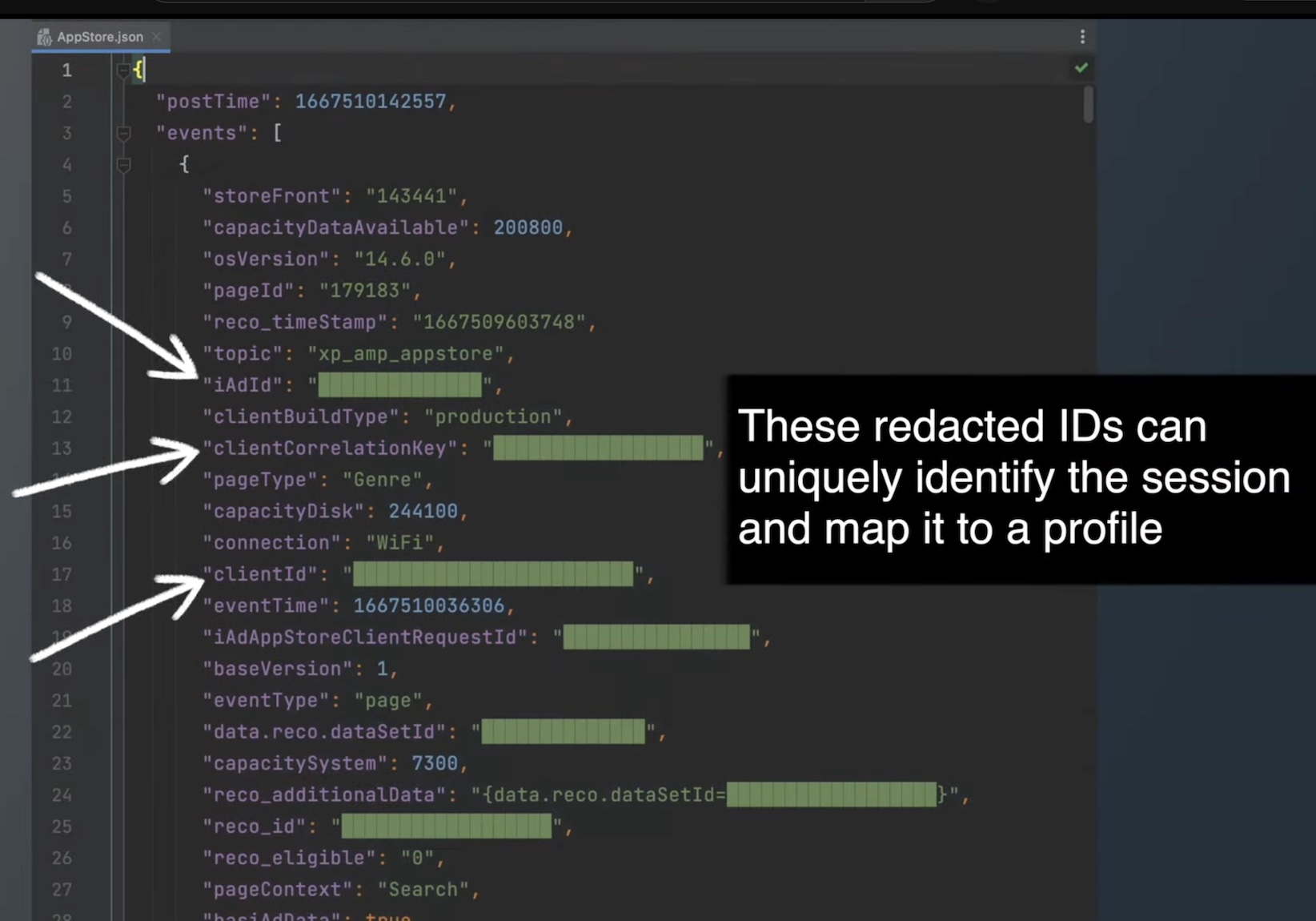 That at first seems mostly like fair game info, doesn't it? But if you say "I don't want anyone tracking me," I can understand why you don't want and, what's more, wouldn't expect all of that pushed up into the pipe. As a developer, it'd be nice if Apple had to ask for that info the same as anyone else. I wonder how much of Apple not truly dogfooding is so they can claim they can't split the software and hardware sides of the house. Because otherwise they really, really should dogfood as if they were any other app maker. Leveling the app-building playfield would improve every user's experience, because Apple could no longer take shortcuts when determining iOS' priorities. "Oh, we can just grab that data from the OS," would no longer be a strategy, and, "Hey, we lose 90% of our conversion with this modal asking for full hardware info," would be enough for iOS to make those decisions move more smoothly, however that might be. Oh, in other news, I finally got a Framework laptop. They had the 11th gen i5 refurb come back in stock for $600, and that's about what I'd pay to play around in this world. If there's a 13th gen CPU update next year that I can use, I might "really" shell out then, depending on how quickly and completely I take to Ubuntu. So far, versus my last foray into Linux on the desktop (admittedly over 10 years ago, I believe), it's nice and fast. Labels: app dev, app store, apple, dogfooding, privacy posted by ruffin at 11/23/2022 08:33:00 AM |
|||||||||||||||||
| Saturday, August 07, 2021 | |||||||||||||||||
|
There's been a lot of pixels spilt regarding Apple's plans to sniff out pictures of child exploitation on personal devices and, if I understand correctly, silently report someone to the National Center for Missing and Exploited Children if they think their algorithms have found it. A couple of quick reactions: First, the rhetorical power of child exploitation as a cover discourse for something else entirely in the last decade or so would be unbelievable to someone from the 1980s. What the absolute heck is going on? Stopping someone accused of exploitation has become akin to a theoretical rhetorical get out of jail free card to justify doing whatever someone wants to be doing. And, in some cases thankfully, like the fellow with the assault rifle at the pizza store, it also still appears to be a practical get into jail quick card if you actually act on that coopted rhetoric. Still, it's a bizarre, collective neurosis. Second, let's talk about what Apple's doing. It seems antithesis to their "privacy is in or DNA" claim, even though some Pizzagates are tragically real. Why are they taking an anti-privacy stand now? Let's be frank: Apple has not been doing great looking privacy-minded this year, as they gave up the privacy high ground when they announced just last month that they plan to literally start selling AAA privacy in iOS once iOS 15 ships. You don't pay, you don't get to be fully private on iOS.
Let's also admit that Apple's not going to be able to create a successful system for sniffing evil images for years. If you've been reading this blog for a while, you know I believe Apple can't QA software to save their life (QA is "Quality Assurance", here meaning the ability to test software to make sure it works well even in unanticipated situations). Here's one example:
Things will go wrong. Someone will be suing Apple for a false positive. And one or two of those people may honestly have their lives ruined. How hashing an image worksTo know why someone's going to get charged who shouldn't, I want to describe how hashing and fingerprinting works, though I really don't want to get into the weeds. So let's grossly oversimplify and say it works like this:
In our case, matching our hash or fingerprint of 357 means there's a 1 in 9,999 chance of actually having 1234567. That's a horribly large chance of a false positive. You could also have 0030507. Or 3335577. Or 2136567. We don't know for sure. Each of those 9,999 matches that aren't 1234567 are collisions. Even so, that's only 10,000 values out of ten million we need to check behind those three hashed digits. Huge potential time savings. Now when "cyber-fingerprinting" large files like images, the numbers are VERY large (lots over seven digits) and the hashing algorithm, though it will have some collisions, is MUCH more exact. The chances of false positives with a true fingerprinting is, let's guess, about the same or worse than winning the lottery. In any event, false positives are very rare. And you should appreciate that. But eventually people do win the actual lottery, and, given enough people, someone will have a photo fingerprint collision. Someone will have a picture that, once hashed, matches the fingerprint of a known evil [no hyperbole intended at all] image. And their life could be ruined in a way that will make some identity thefts feel quaint. Worse, with Apple's software record, there's going to be some bug that says the equivalent of "Any number with a single 3, 5, or 7 in it matches," the National Center is going to receive thousands on thousands of false reports, and we're going to bring down, at least briefly, the very system we're trying to support. And if someone games the system, well, all bets are off. Someone is going to match a fuzzy fingerprint with a meme image specifically spoofed to match a database image, it's going to get popular, and suddenly there are Pizzagates everywhere! No, really, no joke. It's going to happen. 
Apple's true (and legitimate) motivationPerhaps false positives are worth it to expose those who do exploit children. Certainly in theory I think a few ruined lives is worth the good that can come out of this if there's any meaningful reduction of exploitative imagery. And Apple has a clear motivation for doing this, an angle nobody's mentioned yet (that I've heard): Apple is hosting child pornography on their servers right now. Not maybe. They are. I can't say that with 100% certainty, but theoretically, given a billion active devices, you know they are. There are too many sickos out there, sickos have phones, they have evil on those phones, and some of those phones are backed up to iCloud. That's a huge issue for Apple. That has to be Apple's motivation. My guess is that the people with serious problems know other ways to maintain their privacy that Apple won't catch. Apple sniffing Photos (the app) will get some less deliberate criminals. But even at 100% foolproof iCloud sniffing, Apple won't stop exploitation. Should Apple delete apps like those from the App Store too? Maybe! Tough question, but cut from the same cloth. I mean, what a freaking mess. I can't imagine all the smut people likely have on their phone. Heck, Brett Favre allegedly (almost certainly did, right?) sent pics of, well, you know, to a female reporter while he was with the Jets. Very few have signed him off as a habitual recidivist, and I bet most NFL fans still have a mostly positive view of Favre in spite of having and sharing NSFW pics and being a sexual harasser. (Could iOS stop these sorts of pics from being shared? Would that be bad? What if I wasn't a Puritan at heart, would I still think it's bad -- that is, consenting adults can exchange NSFW pictures, right? Right? Ewww.) It's just that this passive, "We're looking through your phone and taking actions based off of its contents without your involvement" that's scariest to the layperson, I think. To jump all the way from absolute, objective evil, let's go right to the end of the grey area where it's almost harmless: Wait. Before I venture much further, let me stop completely to say something: If someone has 1000 matches with a database of child exploitation imagery, even at 95% accuracy (insanely low accuracy, I'd think), statistics say that they've definitely got non-trivial amounts of illegal imagery. If they have 100, they have illegal images. If they have 10? I've got to think probably they do. I have some practical privacy and 5th amendment itches somewhere, but here, they're unimportant. You're using a private company to store illegal goods. Apple sniffed those illegal images just like a storage company could catch a cocaine stash with a drug sniffing dog. You should get turned in with no warning and let the judicial system (at least in the US) figure out where the chips should fall. Back to the grey area discussion... What if you have too many pictures of jaywalking? Movies taken from cars that were speeding? Should you get fines in the mail as if you'd been caught by a red-light camera? How many jaywalking pictures before something must be done? It's more than 2. Is it less than 1000? In all of these cases, what we're talking about is the practical loss of privacy, at least compared to the situation that came before it. This practical, day-to-day loss is starkly different from losing the theoretical right to privacy, which Apple hasn't changed at all without some serious mental gymnastics -- you could argue that today's First World requires a cell phone, and if Android starts doing this photo sniffing too you're trapped in a duopoly, but you also have other options for taking and storing pictures. Again, this is an argument because Apple is hosting your images on their hardware. But wow, it feels like a slippery slope, and a dangerous rhetoric of absolute evil attached to not tripping down it. Labels: apple, Other Stuff, privacy posted by ruffin at 8/07/2021 04:31:00 PM |
|||||||||||||||||
| Tuesday, April 27, 2021 | |||||||||||||||||
|
I’m watching Joanna Stern's interview with Craig and I’m left wondering: What good is hiding the IDFA now if you’d EVER used an app or service before? If you’ve logged in with an IDFA, that service simply has to keep a database entry that says, “Was once IDFA 2204786” and it happily continues to watch and share. It’s like an old phone number. Maybe I don’t have a number any more, but if I used it in App X and App Y last year, if I log into App X today and do anything, X can still share with Y with high confidence that it’s me doing that activity today. You’re still going to know I was looking at that shirt unless I create brand new logins everywhere!!1! Look, that’s not a reason not to hide that softball connection now, but it’s going to help tomorrow’s iOS users a lot more than today’s. The cat’s already out the bag, the horse out of the barn, the chicken has flown the coup. Our privacy is already shot. You’re welcome, later generations.
posted by Jalindrine at 4/27/2021 12:43:00 PM |
|||||||||||||||||
| Thursday, April 22, 2021 | |||||||||||||||||
|
So the title of the latest StackOverflow podcast (I'm not a listener; caught in the sidebar) is "One in four visitors to Stack Overflow copies code". Wait. Wait... you're watching me that closely?
Oh, it was just part of that joke where a pop-over would appear any time you hit Ctrl- or Command-C. I guess that's an interesting fringe benefit of it. (I'll try not to quibble that you don't know it was code being copied, but maybe they're Except... there's no way I'm going to think it was just alive during the April Fools' Day prank. And even if it was constrained to then, let this be a clear lesson of how closely websites are listening to you. I mean, we all already knew this, but it's an example of how seeing something in person is convincing in a way amorphous, theoretical knowledge isn't. Not only can this sort of metric be taken, it is taken easily, and, if you saw that April Fools' popover, it was taken from you. Did StackOverflow listen this closely when it was in version 1? No chance. No, really. No chance. Does it and other mature sites listen to you this closely now? Of course they do. As do your apps. As does your OS. As does... I may have mentioned this before, but I had a time a few years back when I was wearing a mechanical watch, had forgotten my phone (and, therefore, my wallet case), and was walking to the grocery store for lunch with a $20 bill in my pocket, thinking during the walk that, for the first time in likely years, I was performing something completely [well, okay, relatively] off the grid, nothing digital, nothing battery-powered, not even a grocery reward card, on my person. Similiarly, it's rare that I read a paper book -- a true codex -- without thinking that I'm glad Amazon or Apple or whoever is behind Libby isn't tracking how quickly I read each page. Not that I mind being tracked for the most part, and I appreciate Libby telling me about how much time I likely have left in a book before my library loan is up, but it's nice sometimes to be walking to the store with nobody virtually watching. Labels: privacy, stackoverflow posted by ruffin at 4/22/2021 01:17:00 PM |
|||||||||||||||||
| Wednesday, March 10, 2021 | |||||||||||||||||
|
I mean, I've talked about how the great advance of the iPhone was to put a store in our pocket. And I've felt that, at least since we've put our computers on a network essentially 24/7, that we lost control of them. They're ecosystems supporting different, competing programs now, some waring with the OS, some in mutual symbiosis, but all scraping a living in an ecosystem, passively waring with each other. I think the BMG rootkit from 2005 is one of the clearest examples and it didn't even use a network. You put in media. The media [trivially but importantly] rewrote a portion of your OS. And that media was ostensibly just music! (The Night mp3s Became Sentient...) I still believe both -- that are computers are biomes for software growth and that their seeding is powered through making our private spaces into public stores -- though I have to admit I didn't comprehend fully in 2008 how phones would become not a but the storefront (fronts?) for us all just over a decade later. But the commercials still surprise me. Here's one that I received recently upon opening Amazon Music. (I'm a Prime subscriber and get Prime streaming, though I'm also bought into the ecosystem (see?) fully enough that most of my albums are purchased on Amazon, as that means I know I can stream those purchases without worrying if they're in the Prime library this month.)  Looks at how unrelated the items are that come together to make that advertisement. The most galling is that there's no obvious synergy above and beyond simply flexing what they know about you without you ever opting in for sharing it.
Nothing crazy sensitive there, but... why? Why pretend this is special deal? Why would this combination of facts make me more susceptible to the marketing? "I know I've been holding off on getting a subscription before, but if you're doing it because I like ThinkPads, well, let's make a deal!" Look, I still think we should give up on most of this privacy stuff. Kids in 50 years will be scared when everyone doesn't know their exact location and what they're buying and will expect that information to be shared passively, without any action on their part. For most of us, the VAST majority of us, nobody will ever care about our specifics. Even our most secret thoughts don't make for a hill of beans (unless you're Bush's and competitors) to the companies. Unless someone is looking to have a beef (Hormel?) with a group and actively oppress them (a real consideration, as the last few years have shown us), who cares? You can tease out the NFL teams I follow, what sorts of novels I enjoy, my political persuasion, when I'm likely to buy a car... but so what? Most companies have zero reason to make any of that more actionable than targeting (read "spend more on presenting") a few extra commercials towards me. It's really seeing how badly companies bungle the information they have that confounds me and gives me some comfort. It's clear many, and by many I mean "most", have no clue what they're doing. Labels: advertising, amazon music, business, hats o' money, lenovo, privacy posted by ruffin at 3/10/2021 05:10:00 PM |
|||||||||||||||||
| Saturday, October 24, 2020 | |||||||||||||||||
|
From reddit.com:
Exceptionally insightful tidbit from reddit. posted by ruffin at 10/24/2020 12:48:00 PM |
|||||||||||||||||
| Wednesday, August 26, 2020 | |||||||||||||||||
|
Oh noes! Facebook today warned advertisers that Apple's upcoming anti-tracking tools could cause a more than 50 percent drop in Audience Network publisher revenue due to the removal of personalization from ads within apps. despite our best efforts, [privacy changes] may render Audience Network so ineffective on iOS 14 that it may not make sense to offer it on iOS 14 in the future. posted by Jalindrine at 8/26/2020 01:14:00 PM |
|||||||||||||||||
| Friday, May 15, 2020 | |||||||||||||||||
|
I couldn't figure out what about Giphy was worth $400 million, especially since its search seems so bad recently, and too many results are themselves the results of marketing campaigns or similar. Then Gruber nailed it: Of course Giphy is going to retain its own brand. If they renamed it to “Facebook Tracking Pixels”, usage might drop off. I think he's got that one on the nose. Labels: facebook, hats of money, privacy posted by ruffin at 5/15/2020 03:51:00 PM |
|||||||||||||||||
| Friday, February 14, 2020 | |||||||||||||||||
|
9to5 quotes Edison, makers of Edison Mail: To keep our Edison Mail app free, and to protect your privacy by rejecting an advertising-based business model, our company Edison Software, measures e-commerce through a technology that automatically recognizes commercial emails and extracts anonymous purchase information from them. Our technology is designed to ignore personal and work email, which does not help us measure market trends. Hahahahahahaha! MUHAHAHAHAHAHA!!! Yeah, right. Okay. I'd like to hear how that "technology" works. If it whitelists what's sniffed based on known marketing email addresses, okay, sure. If my locally running app is sniffing all my emails for marketing-speak (receipts, whatever), I'm suspicious. And 9to5 does a good job saying why this is wack. I mean, Google is doing this like mad in Gmail, and probably not nearly as safely as Edison. But Gmail also doesn't do this... (again from 9to5) And when looking at the big picture, Edison having phrases like “privacy by design” and “privacy first” on its website can feel misleading after learning about how they scrape and sell personal data. Sell your email client. Charge a subscription. But don't turn on email sniffing by default without telling every customer before they add an account. That's evil. posted by ruffin at 2/14/2020 08:54:00 AM |
|||||||||||||||||
| Saturday, August 03, 2019 | |||||||||||||||||
|
Aren't these painfully obvious phishing attempts? The first you're giving up your exact age. The second you're saying that you're a homeowner. This is obvious, right? Who clicks these? Apparently people who use the CBS News app on iOS. Honestly, CBS should be embarrassed to be part of this. Labels: advertising, fail, privacy posted by Jalindrine at 8/03/2019 01:11:00 AM |
|||||||||||||||||
| Friday, January 12, 2018 | |||||||||||||||||
|
From appleinsider.com:
It's really that easy, folks. Hey, Equifax, Office of Personnel Management, and, um, any freaking hospital -- You know how you keep private information private? You take it off of the internet. Firewalls don't count. OFF of the internet. If you have sensitive, proprietary data, "air gap" that portion of your company's network. If you have to shoeleather data you don't mind getting out from one network to another, you essentially completely eliminate the possibility of a non-geographically confined attack against the data you want to keep safe. That is to say, people in Russia can't steal your data unless your network extends to Russia. Pro tip: The internet extends to Russia. There's this bad joke in the preamble to the Dead Milkmen's song, Bitchin' Camaro (lyrics here, but they're not safe for polite consumption) that goes something like this...
YOU CAN'T STEAL A CAR FROM THE BAHAMAS AND DRIVE IT TO THE US. Get my drift? You want a car to be reasonably safe from US car thieves, put it in the Bahamas. Geography still matters. You want to keep your data safe from data thieves? Don't put it on a network that extends to their apartment. More to the point, why is my personal credit data on the same network as Playboy? Doesn't that strike anyone else as a little odd? It drives me absolutely mad how much we pay every year in breaches for the convenience of not having to separate networks. I can wait 48 hours to know if I qualify for a car loan, okay? Or, crazy thought, how about have the dealership call in the request? Now all that said, please heavens tell me this dude knew to make periodic backups onto at least two jump drives. Or to at least print it out every so often. Right? Labels: internet, networking, privacy, security posted by ruffin at 1/12/2018 02:22:00 PM |
|||||||||||||||||
| Tuesday, December 06, 2016 | |||||||||||||||||
|
From microsoft.com:
I don't know. That sounds like too much to me. And "unintentionally"? No, that's completely intentional. It's Windows' intention to send back everything that's in your RAM, and that could be gigs of information, couldn't it? And boy, a little pushy on what's their "recommended" setting, even though there's very little in there that explains why it should be mine. To, um, "fix" in Windows 10, hit the Windows key, type in "feedback", and then select the "Feedback privacy settings" option.
Then select "Basic" in the "Diagnostic and usage data" section.
I don't think there's an option for less info than "Basic". I also don't remember being asked this when I set up this box, and I'm pretty sure I did the "custom"/manual setup. /shrug posted by ruffin at 12/06/2016 12:08:00 PM |
|||||||||||||||||
| Wednesday, June 29, 2016 | |||||||||||||||||
|
This page about Firefox claims:
That's so not Scottish, it's crap. In case you think I'm overstating, or screwed something up, here's my full Firefox history (full disclosure: I've erased about 12 pages between "Internet for people, not profit" and the Yahoo search for AAA that'd tell you what bank I use):
I can tell you, I haven't opted in to giving out my location everywhere in those pages. And when we check
Explain that, Mr. Mozilla Privacy is Job 1. (In other news, AAA still uses WebObjects.) EDIT: Run the EFF's Panopticlick page now. I always kinda wondered about this (if you get all my browser metadata, you'll kinda know who I am, won't you?), but it's scary to see it in practice. Even worse is learning about this canvas fingerprinting, which is a much more specifically identifying source of metadata that I had no clue existed. /sigh They know exactly who you are. Labels: fail, firefox, geolocation, privacy posted by ruffin at 6/29/2016 10:27:00 PM |
|||||||||||||||||
| Thursday, March 17, 2016 | |||||||||||||||||
|
Richard Clarke interviewed with NPR, and seemingly everyone has seen the moneyball quote. It's worth reading, so I won't skip it, though my interest lies elsewhere...
So good. Now let's move on to the way he thinks. I really like to use this model. When someone oversimplifies a question, and tries to prevent something as a simple binary, as in, "Should Apple be forced to unlock an iPhone?", it's useful to show that we're ready on a spectrum or sliding scale between A and B. If you can put the question in a larger context, its faux simplicity falls away.
Now we can discuss how "grey" unlocking the phone is. There's stuff that's not particularly controversial: Law enforcement should be able stop a masked man leaving a house through the window with a large bag to ask what's in there. Then there's stuff that's not confrontation in the opposite direction: We shouldn't make everyone wear GPS equipped ankle bracelets so that law enforcement can find anyone, any time, regardless of past history or probable cause.* Or that we shouldn't use extreme torture (let's face it, some of the "non-torture" means of interrogating are still, at least colloquially, torturous.) It's a chart.
The iPhone unlocking is somewhere in the grid, somewhere between a burglar in a window and torturing the burglar, but where? And since the OS compromise could apply to anyone, doesn't this topic fall between bank cameras and ankle bracelets too? Which cells on the table are closest? Is there another axis we're missing (privacy)? Those are more interesting questions. As I said, I love to reason like this. It's one of my favorite rhetorical tropes. I remember visiting a friend, and he thought that his milk had turned. His wife said, "But it's before the expiration date! It's fine." In the split second he took to reply, I butted in with, "Well, even if you keep a new carton closed and put it outside in the sun for a day, it's going to turn, regardless of date." Now we had two ends of the spectrum: Perfectly preserved milk good until the date, and poorly preserved milk that could conceivably turn before. I wasn't trying to suggest anyone had treated the milk poorly, which is what the NPR interviewer tried to suggest to Clarke, I imagine to "BAM!" kick the interview "up a notch". Hopefully that wasn't the interviewer's goal, but otherwise, Clarke is right back in the situation I often find myself, with someone who misses the rhetorical move and ends up annoyed that I dared suggest they don't know how to keep their milk cool. "Man, that's a very extreme jump!" No kidding. /le sigh I get it if it's just a friend of mine who misses it, but an interviewer? Your one job was to listen, man. Okay, okay, that and keep the interviewee on track. Which he was doing exceptionally well by himself.  (Luckily both my friend & friend-in-law are excellent mathematicians, and immediately understood the logical grid I was setting out. ;^D) * Though this one is probably less controversial than we think, at least if we carry around cellphones that are powered on. Labels: government, iphone, privacy, rhetoric posted by ruffin at 3/17/2016 10:21:00 AM |
|||||||||||||||||
| Thursday, March 03, 2016 | |||||||||||||||||
|
The reason I haven't used 1Password yet, though its auto-generated passwords have to be safer than what I'm using, is that you've...
Looks like 1Password just started showing the issues with 1.)... From a wrap-up on Michael Tsai's site:
The reply from 1Password makes some sense...
Fair enough, but, again, one mistake in their code means all of your danged passwords are out. If someone is sniffing your loopback, well, all your passwords and 1Password info is out. If they make this sort of mistake in moving things around the cloud, it's no longer a local machine issue. Use strong passwords, and keep your use of them to a minimum. Keep your laptops pretty clean and your home computers turned off when you're not using them. In short, be smart. Don't depend on a cloud service to be smart for you. posted by ruffin at 3/03/2016 10:00:00 PM |
|||||||||||||||||
| Saturday, February 20, 2016 | |||||||||||||||||
|
MacRumors recently ran a story titled, Justice Department Calls Apple's Privacy Case Stance a 'Marketing Strategy', which seems pretty interesting on its face. Is Apple's denial to crack an iPhone simply to save face? There has been a sort of conspiracy theory side to this that's well represented by Marco Arment's post on the topic:
And I gotta admit, when I first read it, I thought I bought it. But when you read through the government's motion to compel, you really don't see any of this. They say they don't have any problem with Apple having a clean room where they created fbiOS, and they can destroy fbiOS as soon as the phone's contents are extracted. Which means part of this is a sort of developer's misunderstanding, both on Arment and Apple's parts, potentially. If you write this fbiOS that allows you to try as many passcodes as you'd like without fear of the OS wiping the phone once, and you know the FBI is going to be back asking for you to do it again, why would you destroy it? Wouldn't it take time to write it the right way again? Simple business math tells you to keep it all around for the next time. And there's the only place where we have a backdoor problem. The backdoor fbiOS is going to live at Apple, and if it leaks, well, it's everywhere. Apple's going to have to play cat-and-mouse with its own fbiOS at some point if it leaks. What's strange to me is that the FBI needs Apple to do this. I have to assume they'll compensate Apple for the time it takes to crack the phone, but why don't they already have this expertise in house? I realize iPhone-as-black-box is much tougher to crack than it would be for Apple, but it's scary that the FBI can't get into these things. Imagine what another nation state could do with their data. Our intelligence is pretty obviously going in blind. More interesting to me, perhaps, is how the government flips the EULA that infects shrinkwrapping everywhere [that shrinkwrap still exists, which is, I guess, almost nowhere now]. If you say this software is yours, and you're going to control it to the point that you can change its features at any time, well, then it's still yours, capiche?
Ouch. Clever. I still hate how badly the current FBI director doesn't understand the Internet [in his public comments], but Apple's losing this one, folks. Labels: apple, encryption, privacy posted by ruffin at 2/20/2016 02:11:00 PM |
|||||||||||||||||
| Thursday, February 18, 2016 | |||||||||||||||||
|
From PCMag, but it's certainly not the only one (I caught it on the CBS Evening News last night. I know, I'm an old soul.)
As I posted in a Disqus comment there... It's time to ensure that patient information is not exposed on the Internet. I don't care if the answer is hospitals keeping their own intranet completely separate, moving data via physical device (my preference) or if we somehow come together to pay for a second, wholly physically-distinct "securenet", we've got to stop allowing companies to be so lazy with data and not hold them accountable for the poorly foresight. The is the difference I don't think even James Comey, current head of the FBI, seems to understand when he parallels encrypted data with locked car trunks you can't open. When it's on the Internet, you've commoditized geography. Anyone who gets on the Internet, anywhere, can knock on your Internet networked data's door. Come on, folks. It's past time to move our personal data to a better neighborhood. Labels: encryption, hack, privacy posted by ruffin at 2/18/2016 11:38:00 AM |
|||||||||||||||||
| Friday, July 10, 2015 | |||||||||||||||||
|
Here's what I don't get about these PII leaks from the government: You don't have to use the Internet. Is it really that tough to lay down some new cable? Why do we only have one large network in the States? Why can't they just take the danged servers off of the internet? If you want information to be safe, you don't put it on a network where everyone has access. There is no perfectly safe firewall, no perfectly safe security system other than not plugging it in. Blows my mind. Was this stuff even encrypted? Labels: encryption, govt fail, privacy posted by ruffin at 7/10/2015 10:26:00 PM |
|||||||||||||||||
|
| |||||||||||||||||


|
All posts can be accessed here: Just the last year o' posts: |
|||||||||||||||||||||
|
||||||||||||||||||||||

|

|

|
About Our Author