
|
title: Put the knife down and take a green herb, dude. |
descrip: One feller's views on the state of everyday computer science & its application (and now, OTHER STUFF) who isn't rich enough to shell out for www.myfreakinfirst-andlast-name.com Using 89% of the same design the blog had in 2001. |
|
FOR ENTERTAINMENT PURPOSES ONLY!!!
Back-up your data and, when you bike, always wear white. As an Amazon Associate, I earn from qualifying purchases. Affiliate links in green. |
|
x
 
MarkUpDown is the best Markdown editor for professionals on Windows 10. It includes two-pane live preview, in-app uploads to imgur for image hosting, and MultiMarkdown table support. Features you won't find anywhere else include...
You've wasted more than $15 of your time looking for a great Markdown editor. Stop looking. MarkUpDown is the app you're looking for. Learn more or head over to the 'Store now! |
|
| Thursday, April 30, 2026 | |
|
Claude Sonnet 4.6 is so much better than GPT-5 mini that I figured I'd look up how much it'd cost to swap. Right now, for $10 a month, GitHub Copilot will let you use GPT-5 mini forever, no limit. Sonnet, however, was sucking down my monthly allocation of "premium requests" so fast (it's the end of the month, so I usually splurge on the model) I was scared to look at what it'd cost. Well be even more scared. Come June 1st, everyone gets to pay no matter which model you use. No more infinite GPT mini. And Sonnet's multiplier is jumping from 1x to 9x!! Look, there's also something on the page about going "from request-based billing to usage-based billing". I don't think this model multiplier multiplier [sic] is effected by that distinction, however. Maybe? I think it's the same charges as now, just 9x as quick. Looks like I get 300 credits now and could get five times as many for $40. That's still not much, and I just use Copilot to pair program sometimes. Well, daily, but not agentic. Five times more and nine times as fast equals lots more than $40 a month. I'd predicted prices for AI assisted coding would go waaaaay up soon. Well, I was right, though now, wondering how long this page about charges changing has existed, I might should've know a month ago it wasn't really a prediction. Starting April 20, 2026, new sign-ups for Copilot Pro, Copilot Pro+, and student plans are temporarily paused. Oh. Oh wow. We're in trouble. Labels: ai, copilot, development, hats o' money posted by Jalindrine at 4/30/2026 11:58:00 AM |
|
| Monday, May 26, 2025 | |
|
Sometimes, I surprise myself:
Labels: development, noteToSelf posted by Jalindrine at 5/26/2025 03:32:00 PM |
|
| Saturday, May 17, 2025 | |
|
From Hacker News' Malicious npm Packages Infect 3,200+ Cursor Users With Backdoor, Steal Credentials:
None of this is amazing or rocket science, which is exactly why it's important. It's not hard to social engineer humans. It does make me wonder about the almost unthinking preference devs can have for "[I don't care if it's] NIH". Not that it started with But if you want to reduce your proverbial footprint, there are ways. Knowing open-source libraries you use well enough to have contributed is one. Not writing an in-house version of something insanely trivial is another. And, as much as Apple's getting slammed for arguing for its own nanny state right now, using IDEs from fairly reputable sources and not believing deals that are proverbially too good to be true are all probably decent ideas too. I do wonder about, say, browser extensions. I have one from the EFF on one box that I haven't looked into for a while -- is it still be updated? What do adblock extensions really do? Luckily these are all in JavaScript so, even if obfuscated, you can still sniff through most of them fairly easily. Somebody should know, eventually, if the most popular get wacky. Right? Though heaven help me if the right vim plugins for IDEs get compromised. I'm toast. (Told ya it was easy.) Labels: development, npm, security posted by ruffin at 5/17/2025 02:08:00 PM |
|
| Friday, May 03, 2024 | |
|
This SO comment links to the best demonstration of off-by-one errors for laypeople I think I've ever run into. (Though, admittedly, the "coming second" and "coming first" terminology was new to me...) Here's the video that comment linked to: Labels: development, logic, obo posted by ruffin at 5/03/2024 10:08:00 AM |
|
| Monday, December 18, 2023 | |
|
Amazingly accurate comic from xkcd is amazingly accurate: 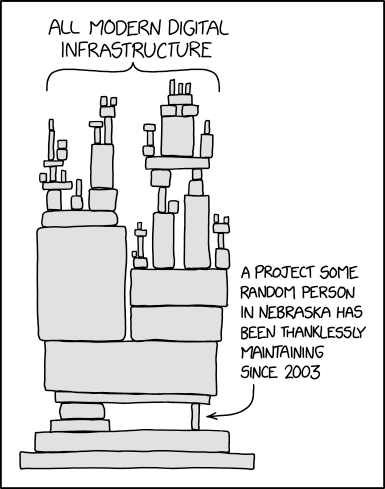 Some day I'll blog about the time a lib maintainer deciding to [literally] say [well, "post"] "Ho hum" about just such a dependency temporarily crashed a reasonably large company's deployment script, but that day is not today. (Luckily it was reasonably easy to fix, but it certainly cemented my usual claim that, "If you adopt a third-party dependency, you should also be routinely submitting pull requests to it.") Labels: dependencies, development, node posted by ruffin at 12/18/2023 09:54:00 PM |
|
| Friday, June 16, 2023 | |
|
Implementing a graceful TypeScript is hard. In theory, theory and practice are the same. In practice, they're different. (Nothing major there, but something as simple as iterating over keys & and their values can be a challenge to do elegantly.) Labels: development, typescript posted by ruffin at 6/16/2023 08:29:00 PM |
|
| Wednesday, January 11, 2023 | |
|
Remember when I said this?
What a naïve time that was. Take this seemingly innocuous question on SO:
And then check this answer:
Wha? Luckily (?) one of the commenters asked the same question.
I mean, um, that requires Inception level cognition to understand. 😏 (Okay, actually it's pretty straightforward, but talk about a lack of discoverability.) What's even more interesting is that dev's answer to the original question, which is this:
AsideOkay, before I point out what I want to point out, note that From ss64.com, a common domain when I'm in batchland:
And we're backOkay, now what I'd like to point out here is the Here's some explanation from ss64.com:
EnableDelayedExpansion command.Variable expansion means replacing a variable (e.g.
And here's a decent example from that page showing how it works in practice.
The output is
Note that the above example has to be in a batch file to work properly. Anyhow, it's an insane rabbit hole that I didn't schedule for this sprint and fell into anyhow. I'm going to cut my losses now that I've warned others who may have been as naïve about batch scripts as I was, oh so long (less than three weeks 😉) ago. Oh good heavens. I guess this makes sense. The first example can be taken by itself as a brain teaser, I think. From ss64.com, again on EnableDelayedExpansion: @echo off Setlocal Set _html=Hello^>World Echo %_html% Got that figured out? If not, sit and think about it for a second before reading more. Got it? Good. Clever, huh?
Labels: batch, cmd, development, noteToSelf posted by ruffin at 1/11/2023 12:27:00 PM |
|
| Wednesday, December 21, 2022 | |
|
Usually, the holidays are some of my most productive days developing. There's no overhead. So many fewer people around means fewer meetings, fewer obstacles, fewer interruptions. Now admittedly part of this is because I can usually pick what I want to do over the holidays, and I'll pick things that don't require a lot of feedback or things that take a really heavy mental lift to complete. That is, I pick things to do over the holidays that require a holiday environment to do well. Win-win. And this week or two of mostly heads-down time is usually incredibly enjoyable. I take a few days off, sure, but going to work when everyone else is away is a vacation -- of a sort -- in itself. This is not [simply] the anti-social position: Long swathes of time uninterrupted is where development gets done. But this year is starting to make clear for me that there's a holiday anti-pattern here with remote work: When the family is home, they don't give a rat's behind about minimizing interruptions. Now, holidays are the worst time to get things done. I'm holed up in the home office, no chance to walk around and clear my head thinking seriously about an issue I need to consider. Folks tromp near or even through the office without any regard for work going on. Dishwashers, loud pipes, clothes washers, winter cleaning, food prep -- everything's much louder than you'd have at an in-person office even during non-holidays times. It's not surprising, and it's essentially ontological, but there's simply no professionalism at home when everyone but you is on break. It makes you appreciate office design a heck of a lot more -- bathrooms away from desks, kitchen areas behind reasonably thick walls... Ugh. Sad first-world problem rant over. I leave you with this (printable):  Labels: development, devLife, productivity posted by ruffin at 12/21/2022 10:42:00 AM |
|
| Friday, December 09, 2022 | |
|
From Ben Thompson's stratechery (hat tip to Dave Verwer at iOS Dev Weekely):
Good timing, Dave and Ben. I'd just seen StackOverflow's header chyron say they don't allow ChatGPT answers, which, if you understand society's use of language well, means...
 It's the door handle that says "Push" because it looks like a pull. That is, the StackOverflow warning tells us that AI answers are so convincing at this point you'd naturally assume those answers are okay to post [for internet points! Points!]. You have to be told to push the door to open. It looks like a pull.  And that, of course, got me googling, and seeing that AI is finally getting close enough to what we thought the Eliza chatbot was nearly doing years ago. As Dave mentions:
We really have been at 90% for a while. But now AI is at 90% for news stories and apparently close enough to start wondering when it'll come for us coders, too. I'm far enough into my career that if it was at 100% tomorrow I would take the pink slip and relax at home, watching some chatbot do my job for me. Realizing I'm still biased, however, I was suspicious of my first take: There's no way the code is going to be good at first. It'll need PRs like crazy for years. My job has, for the last several years, becoming increasingly concentrated on PRs. I think it's mostly about tooling and scrum culture. Tooling makes PRing not just possible but easy now. We can all drop comments on specific parts of code, create PRs to PRs to show how we might do something small differently, and swap branches without having to reset our setup to run them. Scrum culture says we need self-contained but non-specialist teams (give or take) which means we're all expected to have an opinion on someone else's code. It's a full stack developer's world today in a way it wasn't so much in 2000. I could digress for a while on bikeshedding, but, with a high-functioning team, that's mostly good. But when the AIs start crapping out code like a new dev, good heavens, can you imagine? We'll need to train these things for a while. Maybe they'll get good enough that they take to the training really quickly, but -- and not just because of anecdotes like Thompson's post, above -- I think we've got a few more years of heavy PR work before that happens. Labels: ai, ChatGPT, developers, development posted by ruffin at 12/09/2022 07:41:00 PM |
|
| Thursday, July 14, 2022 | |
|
fast-glob vs globby vs minimatch vs node-glob at npm trends:  Why did globby & fast-glob crash this year? Why is minimatch going bonkers? I mean, the answers to each question are in the other question, but that doesn't really tell us why. Why are both happening? I picked minimatch for a node project recently without doing much research -- I'm in "mvp mode" -- and it seems... fine. But more recently I've started trying to figure out how different each package is, one from another, and there's nothing about minimatch that seemed obviously superior. Guess it's like language. Not always easy to know why one turn of phrase beats out another, but once it does, it's like wildfire. EDIT: Here are some sites that explain glob format. I think I found a few of them interesting earlier. (It's another browser tab clean-up day.) Labels: development, glob, npm, trends posted by ruffin at 7/14/2022 04:01:00 PM |
|
| Monday, July 04, 2022 | |
|
From today's post to Baldur Bjarnason's blog:
Long quote, sorry. 100% accurate. I keep wondering why teams can't hit the old, Classic ASP scheduling rule of thumb we had back in the 20th century: One dev, one data entry page (with QA & dbms access!), two days. Today, with the groups I've worked with on SPAs, we're nowhere close. Part of it is quality of developers -- it's the Michael Jordan syndrome. While a GM, Jordan seemed to think players would unlock as much of their potential as he did his, so that's the way he drafted or traded, for potential. Didn't work out that well. Too many architects and technical decision makers think, "I can understand it," or "The internet suggests a dev should be able to do this." Both are followed by, "If you can't, it's your problem. We need better devs." Better devs would be great! Of course, the cost, even the simple feasibility, of finding, recruiting, hiring, training, and retaining those devs gets ignored. Worse, a stack that fits their devs better than a SPA never enters their minds. Or, when you suggest it, you get the same response Baldur describes. And that's the contributor to slow development: We're using the wrong tools for our current devs. If you've got all championship coders (which, I should add, are usually much different folks than championship NBA players, but there is some overlap -- well paid, trusted), make a great SPA. If you've got bog standard devs from outside the Valley, it might be time to do something simpler as long as your use case says you can. Labels: development, spa posted by Jalindrine at 7/04/2022 12:55:00 PM |
|
| Saturday, June 25, 2022 | |
|
Can StackOverflow leave nothing untouched? 🙄😉 Maybe some UXer can explain why arrows with circles around them are better than the old vote buttons with just arrows.  Has this been around for a while and I just missed them? Well, at least I now know it happened between now and 2020.  I worry that some UI changes are made just to keep people employed and busy. I'm sure there's a good argument or 15 to change it. I'm not sure they're always good reasons. I still use a version of SourceTree on Windows from 2015 when I'm on Windows. There's nothing wrong with it. I prefer it. I had a coworker see it on a screenshare and say, "Where can I get that theme?" What if your redesign resources had been spent on anything else? How many sprints saved? How awesome would your app be? Again, not that a redesign is bad. In many markets, simply refreshing the page will drive sales. Just keep in mind the opportunity cost. I realize SourceTree's users are probably more "aged UI tolerant" than most (see my previous post where I admint to using kdiff3), but... How much better has SourceTree's core UX experience really gotten in the last six and a half years? What percentage of their storypoints went to it? Worth it? Idk. (But my guess is heck no. Also note that they've worked through several UI iterations since then. Remember when they used a diamond ring for Commit? And people liked it? /cringe twice. Brah culture much?) In other SO news, I did hit 15k and can protect questions now. I expected to be more impressed when I hit it the way I was with 10k, but... not so much. It's cool, and I'm happy some answers continue to help folks, but I really need to find another semi-obscure but useful tag to sit on. EDIT: Here's some description. There is a comment that this makes the page more accessible for the visually impaired. I'd like to know how. Does that mean I don't see the improvement? (no pun intended) Yeah, but that's the point of asking. Honestly, what's the improvement? Maybe down/up/votes are clearer? There's also a comment that the design doesn't really meet WCAG compliance after all. Apparently they didn't QA dark mode. 🤦 Labels: development, qa, sourcetree, stackoverflow, UI, UX posted by ruffin at 6/25/2022 12:59:00 PM |
|
| Thursday, June 02, 2022 | |
|
As a corollary to yesterday's post about how to measure a poorly performing work culture, here's a well-put warning against getting used to a bad situation.
From Matthew Manela's blog:
Okay, "grind to a halt" is too strong, but what if we say "half as fast as you could be moving". That's enough to matter, isn't it? And I think, honestly, that's possible. It is too easy to get used to the status quo, even when you know it's inefficent or wrong. Habituation is a coping mechanism, and often a useful one! The problem is identifying when you're using it and remembering that you need to fix it soon too. Don't let the perfect get in the way of the good enough, but don't let the good enough get in the way of doing your best either. Labels: business, development, pro tip posted by Jalindrine at 6/02/2022 07:49:00 AM |
|
| Wednesday, June 01, 2022 | |
|
This is a well worded blog post:
Everything we do that doesn't make us "more employable" could be wasted time. I mean, having effort, eg, helps because you get better at estimating stories, and knowing what you need to know to get those high-quality estimates and "ready-ready" stories. That's not wasted time (even if I don't always love those meetings). But if we're coping just to cope -- and when it's safe to say a decent amount of it won't translate to a "more functional" workplace -- that's a workplace smell. Nothing earth-shattering, but I liked the "does this problem make me/us/whoever more employable?" and "do I spend more time coping than learning?" metrics. Labels: business, development, Jobs posted by ruffin at 6/01/2022 07:12:00 PM |
|
| Thursday, August 26, 2021 | |
|
From microsoft.com:
You know, I've often wondered why dependency injection is so popular. It truly is just an inversion of control. The control concerns themselves don't change. It's another variation of "it's all zeroes and ones" where you rearrange some deck chairs to make things look new again. That's not all bad. Cargo culting is much too popular a development mentality. At least rearranging deck chairs makes people look at their architecture closely with fresh eyes, though I fear the result is often trading one cult for another that has better marketing or community buy-in when the decision to join is made. And I often get the answer highlighted in green when the discussion comes up: "But we have to have interfaces so that we can test it!" Um... not always true. There are other equivalent options. And because there are good ways to test that existed before DI, that's really not a good explaination for its adoption. DI isn't free; it has a significant cost. It requires a good head rethread and a ton of boilerplate. Easier testing doesn't (again imo) explain its explosive popularity. (Though I'm very happy it's become the industry's party line to proclaim we value testing so much.) But this line (highlighted in yellow earlier) from Microsoft actually explains the DI advantage:
I really think that's it -- put another way, DI helps enable clean encapsulation that, in turn, fosters anonymous collaboration between coding teams. If I have to learn how to spin up That's what DI does. It's a decent amount of extra work up front to save everyone down the line from being nickel and dimed -- or, when they're protected from having to learn a whole new domain, dollar and pounded. This shows that DI's advantages clearly appeal to enterprises; DI is literally an enterprise architecture strategy, not to improve system load or because it's an inherently superior -- again, for a small team, the DI boilerplate might ultimately slow them down -- but because it can help enable a specific type of work, which is work by multiple teams and workers with very little knowledge transfer overlap. Enterprise development is really a pretty fascinating study in cultural evolution. Labels: development, DI posted by ruffin at 8/26/2021 06:43:00 PM |
|
| Wednesday, February 03, 2021 | |
|
See previous post about too many bad devs running around. It's not brand new. They are and have been everywhere. From newscientist.com:
Because of course they did.
Would non-windowing require a deeper refactor? Yes. Should they have done that then? Maybe? The real question is if the developers let their management know the limitations of the fix, and if the managers told the customers. Because if there's one thing that's lacking as much as good developer instincts in software development, it's managers who can spell "success". From the same article:
"Old legacy systems" you say? That's where code is spaghetti? Lolls. What you should say is, "any mature codebase". There are always There is no clean code in production. I mean, there is, and if you handle your method signatures correctly, there's more in your code than elsewhere, but, um, there's not much idealistically pure, ivory tower type sample code making people money. And if there is, it's about to let them down in some serious-yet-unexpected way. Related..., if you wrote the preceding blog entry in Markdown:
You know what doesn't look like a strikethrough at all, John? Labels: developers, development, fail, markdown posted by ruffin at 2/03/2021 11:44:00 AM |
|
|
StackOverflow flashback... Not sure who wrote this comment, and it's a little strongly worded, but man, they're on the money. ;^)
I hope that makes sense. Sure, it's not bad to include some safety checks client-side, but they really are just niceties. Maybe you check a few things for your user's user input without a round trip to the server, but only after you've already put those same rules into your server's code. (This, btw, is why Node is so intriguing. Write once with both sides in mind and you get client-side niceties for "free". Otherwise, if you push me to shoving, I'd say an mvp should only have input validation on the server [in ways that make it easy to return error packages to the client to display]. (And thus the Honestly, this dev taking me to task by saying people can get Labels: development, security, software, SQL, stackoverflow posted by ruffin at 2/03/2021 10:25:00 AM |
|
| Thursday, January 09, 2020 | |
|
I don't recall when I signed up for it, but I routinely get a newsletter from Baldur Bjarnason about software development with a focus on web development. His new year's email includes some points on JavaScript frameworks that I'm suspicious I like because they so closely match mine. But what they so clearly indicate is that web development has become a field whose outward appearance and, all too often, local practice, has been completely co-opted by the needs of the largest of enterprise corporations. (Words in bullets are his. All emphasis is mine.)
He continues by comparing TypeScript -- and I think he means more specifically "enterprise TypeScript development", because there's lots to enjoy about TypeScript the language, nothing inherently evil about it -- to enterprise Java of 20 years ago.
Then he has a few points that serve as a sort of manifesto for the non-enterprise developer.
I'd also ask people to take a close look at how they define what's an SMB project and what's an enterprise project. That is, defining projects by the size of the corporation that produces them isn't always -- heck, isn't usually -- the best metric. Where something becomes "enterprise" is when you have hundreds of people working on the same project, in the same codebase. What npm/library-based bundling buys you is the ability to firewall smaller projects from each other. If someone writes a horribly inefficient page that no rendering library could solve without magic... ... your development process already includes a baked-in firewall to ensure that code doesn't adversely impact the rest of your system. You can stitch together completely independent projects easily, iff you really need to do that stitching. But how big is your day-to-day work, really? How many of the problems "solved" by mass package import could have been solved reasonably well for your uses with a (think what's often derisively called a "NIH syndrome-induced") roll-my-own, homebrew solution? Put another way, how many developers are really part of your specific product? If it's not hundreds, ask yourself how much time you'd save on developer ramp-up, maintenance, and new development if you too used "jQuery and plain old JS—maybe with a couple of libraries imported directly via a script tag". Even in a team of "just" 20-30, the resource savings from going just 25% faster (a conservative cost of doing framework-style development in my experience) are unbelievable. I'm not sure I know when going "full framework" is the best idea. At a conference, some friends of mine (coworkers) managed to corner a guy who was then working at Google on AngularJS (before Angular 2+). We talked to him a bit about AngularJS' pain points and how they solved problems of large DOMs, as our Knockout.js-based system was getting crushed in our more dynamic, feature-rich UIs. His basic comment was that you can't fix these issues easily, and there was no silver bullet. Inefficient or complex UIs are trouble no matter where you build them. The problem here was browser performance, which by definition isn't an SMB or enterprise problem. It's a client-side rendering one. Frameworks don't fix these issues. "Full framework" dev doesn't provide solutions to day-to-day problems, it provides the passive coordination that allows the amalgamation of code from hundreds of developers working at once. Is that really the state your team finds itself in? Why would you want it to be? And then here's a final comment from Bjarnason about how the thinkspace of development has been dominated by the enterprises -- he does a good job in the balance of his new year's points discussing how we see so much enterprise-specific information because those enterprises have a vested interest in making that come to be.
Anyhow, it's a good, thought provoking post, and worth a full read. Labels: development, enterprise, javascript, npm, web, web 2.0 shiite posted by ruffin at 1/09/2020 10:06:00 AM |
|
| Saturday, July 27, 2019 | |
|
Interesting addition to my “low end apps are cool” posts (Uber, Spotify) from Michael Tsai’s post on Fast Software is the Best Software:
I was wondering this morning before seeing this why all software isn’t written like it’s designed to run on low end machines – not literally for the low end, necessarily (though that’s a great, and the most practical, benchmark), but for minimum footprint and maximum performance. Do we create bloat in our apps always in the interest of developing faster? Developing cheaper? My bet is no, we often create bloat simply because nobody is minding the henhouse.1 What happened to craft? What happened to wanting to support the greatest number of users? What happened to wanting to create the smallest, fastest apps? IE 8 my scheduleThis reminds me of a time (I’ve probably recounted this before) when I was on a team developing a schedule for a SaaS. When we were getting close to release, we got a little more serious about testing on IE 8 because, guess what?, a major logo client required it. But guess what happens when you take a company of devs and you don’t tell them they have to use IE 8? They develop on Chrome (or, back then, Chrome and some Firefox/Firebug).2 And guess how often they use boxes that mirror what the users are going to use? Never. Literally never. Guess which is a better approximation of end users’ experiences with your app, the phat dev box with Chrome or a four year-old tower with IE 8? I think this is a lot of why software runs slowly. And it’s not simply that devs use better hardware, it’s that the difference between great hardware and bottom of the line – all the way down to below-TracFone-level Android phones in third world nations – is much greater than we (as devs) ever anticipate as we code and develop. Unless devs develop and test on representative hardware, they’ll never truly value their app’s performance. Why don’t we want to write thinner apps? Why isn’t this appreciated? Have you ever heard someone ask why you have and if you need each dependency your repo’s taken on? Have you taken a look yourself? Sometimes it’s just as simple to create thin apps as thick when you’re starting a greenfield project. Laying down a good, thin foundation and making platform-accessibility a goal from the start creates better software. 1 Also, he’s right about Sublime Text. It’s insanely speedy. So many apps seem to keep pace through the years. It upgrades its version, you upgrade your box, but the app is still about the same speed. Sublime’s performance, on the other hand, screams now. 2 Did we have Safari specific errors on macOS too? Yes, yes we did, for exactly the same reason. Nobody was using the platform. Labels: development, performance posted by ruffin at 7/27/2019 07:51:00 PM |
|
| Wednesday, July 01, 2015 | |
|
As evidenced by the last post, I've been boning up on my JSP & Java Servlet skillz this week as we prepare to migrate an app I prototyped in Node over to a WebLogic host, its eventual home. I thought it'd be safe to develop against Tomcat, but wasn't absolutely sure, so I started googling around a little. So far, so good. Looks like vanilla Tomcat has, at worst, a subset of the features of every other major servlet container. One of the most promising articles by title, WebSphere vs. JBoss vs. WebLogic vs. Tomcat – presentation from the InterConnect 2015 (it's got everything! All the major servlet containers! It's from this year!) turned out to be a painful foray into marketing-by-blog from IBM, but there was one bonus, the slide (which is now above, but will later be) below:
So 90% of TOC for a software system isn't licensing. That's probably true to no-worse-than-trueish. An interesting exercise, however, would be to put numbers -- okay, okay, first you have to recategorize ("Developer, admin and end-user training cost" falls in the same category? RLY? etc) -- beside each of the other categories. Though it's worth saying that a 9% savings is significant any way you look at it, especially for garage-companies where developer and admin cost is paid in elbow grease. Labels: development, management posted by ruffin at 7/01/2015 01:57:00 PM |
|
|
| |


|
All posts can be accessed here: Just the last year o' posts: |
|||||||||||||||||||||
|
||||||||||||||||||||||

|

|

|
About Our Author