
|
title: Put the knife down and take a green herb, dude. |
descrip: One feller's views on the state of everyday computer science & its application (and now, OTHER STUFF) who isn't rich enough to shell out for www.myfreakinfirst-andlast-name.com Using 89% of the same design the blog had in 2001. |
|
FOR ENTERTAINMENT PURPOSES ONLY!!!
Back-up your data and, when you bike, always wear white. As an Amazon Associate, I earn from qualifying purchases. Affiliate links in green. |
|
x
 
MarkUpDown is the best Markdown editor for professionals on Windows 10. It includes two-pane live preview, in-app uploads to imgur for image hosting, and MultiMarkdown table support. Features you won't find anywhere else include...
You've wasted more than $15 of your time looking for a great Markdown editor. Stop looking. MarkUpDown is the app you're looking for. Learn more or head over to the 'Store now! |
|
| Wednesday, September 03, 2025 | |
|
Was writing an email to a buddy who likes sports, and mentioned that I know someone who lives in DC. The balance of the email was about the Football Team, but then I wrote...
And then the textbox on gmail.com suggested "baseball". The Nationals are a baseball team. Nats is the nickname. Now you could convince me that it actually screwed up royally and thought the balance of the email (which I'll spare you) was actually baseball related, not NFL, but there's a non-trivial chance it got that one right. It's going to get to the point we won't be able to tell when someone's going senile based on their emails. Overall super-minor, but the ramifications are actually pretty large. It's reading my email realtime for non-grammatical context, which means it processes even the parts I take out. Is that kept in memory? How long is it stored? Did I sign up for this? posted by ruffin at 9/03/2025 04:57:00 PM |
|
| Wednesday, January 19, 2022 | |
|
How does Gmail not realize this is spam?  I've gotten a run of them -- for months now. Each talks about a Norton subscription. Each comes from a bogus address. Each has some non-English gibberish text somewhere obvious/important: The subject or early in the message. Not only does Gmail not categorize as spam, it puts it into Primary. I think that means it actively identifies it as a receipt? And the same phish appears to swim over a reasonably wide range. I saw a Nextdoor post where someone random near me got hit with exactly the same thing. And of course we're just the communicative tip of the iceberg. If, just a short 30 years into widespread email use (🙄) we can't keep our mail streams clear, can you imagine what happens in avatar-enabled augmented reality? That is, AR's going to have a heck of a spam problem. Can't wait to see how it manifests. Labels: AR, avatars, gmail, gmail fail, spam posted by ruffin at 1/19/2022 11:15:00 AM |
|
| Wednesday, September 29, 2021 | |
|
Remember in April when I complained about how hard Apple is selling me services, and how it made it sound like I would lose email? Guess who else is selling me services? You got it. Google. Well, specifically Gmail.  That look familiar? 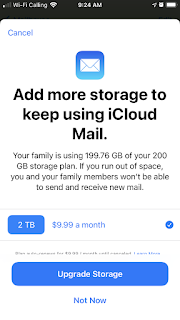 But Google allows me to "learn more" with the weird hamburger straw menu.  Let's give that a shot.  Wait, okay, that's actually kind of helpful! has:attachment larger:10M is a neat search suggestion to get rid of some oversized emails. Unfortunately I only have 125 that match. That's not nothing -- 125 at even just 10 megs each is well over a gigabyte, giving me nearly 8% of my 15 gigs of free space back and hopefully silencing this message for a while. But what really hits me is the coincidence that Apple and Google are both yelling at me to pay something [or pay more in Apple's case] at the same time. Interestingly, Outlook seems to hard cap at 50 gigs even when you're paying $70 a year (includes 1 tb OneDrive). Google offers 100 gigs in gmail for $20 a year. Apple lets you lump email in with your iCloud, so potentially 2 terabytes (!??!), but that's shared with your iCloud backups, messages, and pictures, and runs $10 a month, so... Fastmail charges $5 a month for 30 gigs and $9 for 100, which seems to be obviously too much until you recall they aren't profiting on what's in your emails. Regardless, what getting caught on both ends with "upgrade now!!1!" adverts tells me is that companies aren't scaling storage over time, as it becomes cheaper for them. And storage isn't being updated year over year because having people run out of storage is a profit center. Not crazy, but not coincidental either. This is a decided, "let's all charge for services" play by all the companies. There's money in them thar hills. Labels: apple, cloud, gmail, Google, hats o' money, icloud, outlook posted by ruffin at 9/29/2021 12:11:00 PM |
|
| Wednesday, January 27, 2016 | |
|
It's well past time. Gmail seems to finally be really merging the sort of intelligent, context-specific search Google provides for you on the web* with searching on Now when you're searching for a frequent flyer number or shipping status (for example), Inbox will show it at the top of search results–no more digging through individual emails to find what you're looking for. In my spare time, I'm still slowly slogging my way to creating a mail client I'd want to use, and these are the sorts of features that are going to be difficult to copy. Not impossible, but difficult. It'd be interesting to know if this code is shared somewhere else in Google, or if the Inbox team did it themselves. The big advantage of being a one-person shop is that you can turn on a dime and release things without waiting for committees to sign off on design, function, branding, and reuse. But that opposite side is, of course, that you only have one schmoe working for you, and, at least in my case, that schmoe isn't going to have millions of people's worth of data from which to pull patterns. * With the usual caveats: if you have a Google account, and it's turned on when you search, which many prefer not to do. I've used DuckDuckGo a bit recently. It's my default search engine on my iPad and a few browsers. It's not as good as Google yet, and I wonder how much of the advantage is due to these potentially privacy invasive moves Google can pull off. posted by ruffin at 1/27/2016 09:49:00 AM |
|
| Tuesday, December 17, 2013 | |
|
Fewer Gmail Users Are Opening Retailers' Messages This Shopping Season - NYTimes.com: The flip side for retailers is that by storing images on their own servers, they received much more information about Gmail users who opened their messages, such as their locations. Now, they know someone opened an email but not much more. But what does that mean exactly? First, how do they know you opened their email? Second, how did they know your location before? Just because the request came with your IP and other metadata? The post in general is pretty interesting. It pretty clearly shows a Google who is lessening the usefulness of email as a junk mail marketing tool -- adverts automatically skip your inbox, and metadata from image requests stay with Google now. And that makes sense, of course, since Google is in competition with just those folks. All the more reason not to use gmail.com to access your mail, and to always access mail images via proxy if you bother to access them at all. Edit: A later paragraph is just as/even more interesting for a different reason: Gmail shoppers, who tend to be wealthier and more tech-savvy, clicked on retail emails 14.5 percent more than Yahoo users before the change to Gmail, according to Epsilon. But by October, the difference had shrunk to 4.2 percent, indicating that Gmail users were ignoring marketing emails more often. Labels: gmail, hats of money, privacy posted by ruffin at 12/17/2013 06:57:00 PM |
|
| Tuesday, August 28, 2012 | |
|
Is it just me, or is Gmail's online interface becoming too cluttered? It's trying to be a desktop client. The beauty of Gmail in the browser is twofold: Clean interface and great searches. That's it. Heck, with the phone and chat UIs, it's morphing from a complicated desktop application to a desktop. That's bad. It's strange to think that sometimes not being quite done is your advantage, but after spending a little time in the fairly refreshing Outlook.com interface (rough around the edges, sure, but clean, with improved search), Gmail hits me as too cluttered. Microsoft is potentially doing something right, though it might take Windows X before they get a feel for it. They're finally doing the Apple trick -- give everyone 90% of what they want better than they expected it, and tell them that's it. You're not getting your last 10%, because there are six billion last 10%s. We're giving you what we want, and you're going to like it, because it's smooth. Google has, I think, finally [at least temporarily] plateaued. Wonder if Yahoo can make a comeback. posted by ruffin at 8/28/2012 09:10:00 PM |
|
| Thursday, August 02, 2012 | |
|
From Outlook.com Helps Microsoft Fight Google for the Workplace - The CIO Report - WSJ: Microsoft’s launch of the Outlook.com email platform, designed to replace Hotmail over a period of time, will help the company fend off Google’s challenge for its business in the enterprise. This guy's got it. Hotmail's going away as a site only because Microsoft thinks this will be the silver bullet allowing it to change the brand -- they've already tried to make Hotmail into MSN and WindowsLive, neither of which worked. It's not going away because consumers don't like it. It was the Coke of consumer email. It's now the Pepsi, but only barely. It's nowhere close to (ie, lightyears ahead of) Yahoo's Snapple. The crucial point is that Hotmail for consumers is fine. And Microsoft would love for you home users to keep using the site and clicking the ads. But Gmail is apparently making so much more cash on providing corporate (and university) Gmail "solutions" than advertising that Microsoft would just as well forgo the consumer ad revenue if it means they can sell to the enterprise. So poof, hello comes Outlook.com, adless hotmail with a few social features thrown in. Here's why it's a long-term winner (where "winner" here only means "better idea than just hotmail.com"):
The two biggest barriers to entry keeping business and other institutions from considering Hotmail for their email solution are gone. Profit. Labels: email, gmail, hats of money, hotmail, microsoft, outlook fail posted by ruffin at 8/02/2012 07:57:00 AM |
|
| Friday, January 06, 2012 | |
 From findbigmail.com. Security is important to us. We only see the size of your emails, not their contents, and we never see your password. Gosh, I hope so. Dumbest thing I think I've done in a while. posted by ruffin at 1/06/2012 03:12:00 PM |
|
| Wednesday, May 11, 2011 | |
 Dynamic Google doodle draws dancers, complaints | Deep Tech - CNET News: Today's Google doodle honors choreographer Martha Graham's birthday--and with animated dancers revealing it, the doodle also showcases the company's push to build a more dynamic Web. The interesting thing here is that the animation is apparently all done with dhtml instead of, say, an animated gif, which would have done just as well. The code is a mess. And using the javascript engine to power your animation as well as your keystroke sensing is a little cannibalistic. It's like ethanol -- there's no inherent reason that corn prices should be directly and immediately influenced by gasoline price until we started feeding our mouths and tanks with the same stuff. It's a ill-fated confluence of convenience. Google's "everything's a nail" attitude also reminds me of what the Free Software Foundation is trying to call "The Javascript Trap. Because Gmail's interface online is full of proprietary code, the FSF has decided they'd like to tell their mail list subscribers to stop using that fully-featured web app. You may not be aware of the dangers of JavaScript -- a problem we've deemed The JavaScript Trap -- proprietary software running on your computer, inside your web browser. It's an interesting line, but a flawed one (my first reaction was a solid "Oh noes!"), I think. The Javascript is still out there for you to review and edit. It's heavily obfuscated, even moreso than decompiling many Java or .NET apps, I'd argue, but it's still out there. The FSF should be more worried about the proprietary software on the Gmail servers. They suggest IMAP and Thunderbird is the way to go, which is nice, but they obviously haven't used Thunderbird recently. (I kidded hyperbolically) I wonder if Javascript on your browser isn't in some sense a use of a little-"o" open source medium that is more in tune with FSF than, say, Outlook. Sure you've still got the assembler/machine code of Outlook -- any app is just a bunch of zeroes and ones -- so you could argue it's open too, but Gmail is several steps closer. I did email Mr. Lee, who sent out an email to me (and everyone else) saying that I should stop using Gmail's online interface. Here's a bit of my replies. Though I expect Google's Javascript is copyrighted, it would seem that studying the Javascript is still possible, isn't it? I'll admit I haven't checked the code, but each include file, etc, is downloaded to your browser, so we're a few cURLs away from the source, aren't we? What's different here? Open source is, ultimately, all about the human readability, isn't it? The "Javascript trap" really means that you can't stop at open. If I obfuscate my Java as part of the compilation process and release the obfuscated code, it's not really Open is it? Still, Google's mastery and overuse of Javascript is an excellent point. What are they doing with our browsers? Why are they willing to compromised their own functionality to recreate the animated gif or SVG? And even though their interface seems very simplistic to the point of minimalism, which platforms are part of the Google web and which aren't? Labels: F/free, FSF, gmail, Google, javascript, online distribution, open posted by ruffin at 5/11/2011 11:02:00 AM |
|
| Tuesday, January 12, 2010 | |
 Why is it that Hotmail continues to include ads for itself in emails sent by its service? We do understand that part of why Gmail's caught on is that it can be used exactly like our old, conventional ISP-based mail service? If I send Gmail, it doesn't have ads in the text of the email, only in the sidebar, menubar, etc if they too use Gmail. Gmail users throw privacy to the wind and accept ads because the Gmail interface is that good, but also because we get everything we used to get from an ISP, plus portability, if we want to use our old mail handlers. (Everything but the ability to email .exe's, that is.) Why Microsoft/Hotmail continues to append "spam riders" to their users' email, I don't understand. Spam riders will keep many Gmail users from ever considering switching. Perhaps (and I suspect this is part of the case) they've given up on growing and would rather simply "monetize" what little they've already got, like when AOL's prices stayed insanely high for dial-up (and even AOL access once users were using someone else's high speed access) and priced themselves right out of business in the long term. But rather than milking cash, why not make try to make a better interface than Gmail's? Maybe they could remove the insane MSN tie-ins, maybe even keep the spam riders, and take out the annoying ads inside of Hotmail? Right now there's no war for email, not attempt to out-innovate Google. There's only Hotmail and Yahoo trying their darnest to make more profit as their ships all but sink. Labels: email, gmail, hats of money, microsoft, yahoo posted by ruffin at 1/12/2010 12:17:00 PM |
|
| Friday, January 08, 2010 | |
|
From Sidebar links - Gmail Help: Ads and Related Pages If it's automated, it's okay? Though that doesn't even explicitly mean that your privacy is protected -- an automated process could certainly fill a database full of some pretty compromising information from your emails. Heck, has anyone seen the search results AOL let slip in 2006? I'm not sure how I missed it, but I got the feeling that I'd never peered quite so intently through a keyhole into someone's most personal activities until I looked at some of those files. And they were, of course, created by an automated process. But the implication, I think, is that the automation removes the personal connection. There is the feel of a double blind provided by the code between your personal email and corporations' ad copy. From the page above's "Learn More" link: Gmail is a technology-based program. Advertising and related information are shown using a completely automated process. Ads are selected for relevance and served by Google computers using the same contextual advertising technology that powers our AdSense program. This technology enables Google to target dynamically changing content such as email or daily news stories. No humans will read your emails? So now we won't even promise that humans won't be reading the key terms from your emails? Makes sense from a software engineering bias, but not from one of personal privacy. Neither automation nor collective ("non-personal") data eliminate threats to privacy. This, unfortunately, hasn't yet stopped me from using Gmail. posted by ruffin at 1/08/2010 08:33:00 PM |
|
| Thursday, October 22, 2009 | |
 I've gotten some emails from someone recently whose gmail adverts aren't noticeably related to the content we're discussing or the sorts of ads I've seen in the past. They are, however, linked to the sorts of work the sender has done while programming in the past. Does the sender (and what some algorithm says about the sender) help determine ads? Do we project ye olde digital proverbial ethos with our emails linked to our online presence/brand as defined by some compilation corp? I mean, it's not a bad idea from the pov of profit if Google is doing this, but it seems close to an invasion of privacy. No reason everyone should be able to glean from ads connected to my emails that I, um, have read pretty much every codexically amalgamated word written by Frank Herbert [and much too many by his son, which, Dreamer of Dune excepted (barely), probably means any number above 1000]. EDIT: Now that I've replied, the adverts are gone. How the heck does Gmail decide when to show ads? Sometimes you just get offers to connect to Google Calendar or Maps, and sometimes there's nothing, though when it was just one email in the thread, I had probably twelve ads down the right hand side. Weird. Wow, busy day. Was going to upload the picture and the upload form for Blogger now has a pretty complicated "terms of service" which, though it's dated 2006, wasn't there last time I uploaded something. So we'll link offsite. Here's the text: In addition, by submitting, posting or displaying Content which is intended to be available to the general public, you grant Google a worldwide, non-exclusive, royalty-free license to reproduce, adapt, distribute and publish such Content for the purpose of displaying, distributing and promoting Google services. You mean services like Google Press' book on someone famous who just happened to be in a picture I uploaded? Wow. And so all your family snapshots are belong to multinational corporation. Make your time. posted by ruffin at 10/22/2009 10:12:00 AM |
|
| Tuesday, February 03, 2009 | |
You are currently working in Flaky Connection Mode Funny. I'll give them funny. Labels: gmail posted by ruffin at 2/03/2009 05:05:00 PM |
|
| Thursday, October 02, 2008 | |
|
I'm still using both Firefox and Chrome, after believing I was done with the latter. Things like having reader.google.com (and later gmail and google docs) offline with Gears is nice, but the real advantage of Chrome is still the few simple tweaks of the nav bar. Want to go to gmail.com? Right now, it's ctrl-l, g, return. Bam. Dictionary.com? ctrl-l, d, return. Man, that's nice. Downsides are lacks of keyboard nav in page and the still incomprehensible inability to use Blogger markup shortcuts, like ctrl-i for italics (which actually inserts "<span style="font-style:italic;"></span>"). So there's still no winner, just a heightened sense of frustration. posted by ruffin at 10/02/2008 01:44:00 PM |
|
| Thursday, September 11, 2008 | |
|
I'm just about done with my daily use experiment of Chrome, and am back to using Firefox right now. Firefox seems quicker, crashes less [for me], and, well, I'm probably just more used to the browser. Strangely, FF can activate Blogger markup shortcuts (like ctrl-i for italics) and Chrome, in my use, can't. (That said, on my G4 running OS X, FF 3 is too slow for me to use daily. There, I use Safari.) So why would I use Chrome again? Seems obvious: Gears, although now that I look at it, Google has Gears for IE and FF! Gears is the interface that lets browsers go offline, for example, as in my post on Google Reader offering to make itself accessible offline. That's nice, and I'll bet that Chrome does Gears better than any other browser. It's designed to be a Gears host from the start. Anybody, iirc, can code up a Gears application, yet I still have to think it's going to be Google first and Google best. This means Google went for Embrace and Extend, embracing the browser, and making an extension that ensures that your browser does a superset of everyone else's. That there's Gears for FF and IE and that anyone who learns can code for Gears makes it appear like Google's being altruistic, but the fact is that Google's not just dealing the cards, they're deciding which ones to print as well. Google's continually more evil, imo, and it seems to be an evil born of success coupled with a desire to expand. Many of the things they do are Good Things (unobtrusive, almost useful ads, POP and IMAP Gmail access, making Gears accessible, if not Open and Free), but the bloom is off the rose for me. By the way, the KHTML project now seems to be the most interesting Open-Corporate encounter in the software world. There's Safari, Chrome, OmniWeb, the vaporware that is Sun's JWebPane, and, of course, Konq all sharing the same parental codebase. What exactly is the sweetspot that makes KHTML so attractive, and so attractive versus Mozilla code or internally written code? (And let's remember that IE comes from Mosaic, even if MS is idiot enough to say that IE 7 has no Mosaic code (look, if you started with a codebase that large, unless you start over from scratch, the traces of the original are always going to be with you... Always.) I know some of it is obvious: Smaller codebase, good license, etc. But is the code particularly well written? Commented? What specifically makes it so much better than the alternatives that the last two major corporations (three if we count Sun, which we won't, yet) that released popular browsers have all used it? Labels: chrome, firefox, gmail, Google, khtml, microsoft, mozilla posted by ruffin at 9/11/2008 07:49:00 AM |
|
| Sunday, September 07, 2008 | |
|
Mr. Beal's cleverly named businessweek.com piece, Why Chrome Won't Crash Windows, misses a key point in understanding Chrome's importance. First, a quote: It's our infatuation with the Google brand, more than the technology inside, that will boost Chrome's market share and further extend Google in our daily Web activities. As for being a Windows or Internet Explorer killer, don't count on it. Did Gmail kill Hotmail? Will Google Docs kill Office? Did Google kill Yahoo? How about Google Reader -- it's killed nearly every stand-alone RSS reader I've tried. Now each of these use the browser as their host platform. I've already shown Chrome's ability to take Google Reader offline. Does Firefox do this? Not yet... If Chrome can extend Gmail, Reader, Docs, Maps, search, Scholar, Books, etc etc etc onto your desktop, the OS will finally become a commoditized complement. This kills Windows. Rather, it negates the advantage one OS has over another, in large and almost exclusive part. Again, Google is with chrome making Java's play, and they are, to date, doing it successfully. There's more than just a cute icon to be gleaned from Google's portrait of Java applets as a bunch of dancing moons. What Google is saying is that where Sun failed so miserably and laughably in Web 1.0, Google's winning in version two. Google is killing the OS in ways Sun wanted to with Java and couldn't. It'll be interesting to see if Google can succeed. Labels: browsers, chrome, dancing moons, firefox, gmail, Google, java, microsoft, web 2.0 shiite, windows posted by ruffin at 9/07/2008 08:31:00 PM |
|
| Monday, August 25, 2008 | |
|
From UNC's student newspaper: Google has created a new program specifically designed for college students. The education edition of Google Apps includes e-mail service in addition to applications like Google Calendar and Google Talk, an instant messaging service. Well, why Google is interested in providing the service for the university makes perfect sense -- most will likely use Google's own web application to interface with email, and that means lots of ad revenue. And I suppose as long as you can use POP3 or IMAP to view your Google-hosted mail, I shouldn't complain. Still, what are the chances that Google stands to net more than $400k a year from your students? That is, could the university not invest in making its own, ad supported online interface and come out ahead in the long run? I would prefer that capitalism kept its sorry grubby hands away from academia, even if the university made the cash -- as if a capitalistic state institution of higher learning were still an option. Labels: acad, business, email, ethics, gmail, Google, market posted by ruffin at 8/25/2008 02:03:00 PM |
|
| Sunday, April 13, 2008 | |
 When I look at Gmail's interface, there seems an obvious omission in there when you've got the option "Open as Google Document", which is "Print". Why download the file locally? Why have it live on your terminal at all? I've got a print server on a wireless network at home. I wouldn't mind installing something from Google that allows me to route printing there. In fact I'd much prefer it. When I look at Gmail's interface, there seems an obvious omission in there when you've got the option "Open as Google Document", which is "Print". Why download the file locally? Why have it live on your terminal at all? I've got a print server on a wireless network at home. I wouldn't mind installing something from Google that allows me to route printing there. In fact I'd much prefer it.The interface could be a pretty easy one, I think. If you had a specialized Google Talk application, perhaps running on port 80 relying on the client pulling more than Google's servers pushing jobs, I think you'd have it. posted by ruffin at 4/13/2008 12:48:00 PM |
|
| Tuesday, April 01, 2008 | |
|
Gmail: Google's approach to email: Is there a limit to how far back I can send email? This is one of those deal where it's funny because it's true... That is, there's really nothing about an email's format other than a few fairly involved, but accessible, ASCII edits that prevent you from sending emails that, for all anyone could check them for, appear to have come from the past -- or future. You may have noticed spammers doing this to send messages from the future that stay atop your Inbox essentially until you deal with them, or there's the issue of when I've let my laptop's battery die and send a few emails before the clock syncs back up online. Hello, forty year-old email dates... If the recipient doesn't have their inbox arranged by "date received" to deal with this and the spamming issue (or even more rare, a clean inbox!!!), these "antiques" might never be seen. So though Google thinks they're joking, they really aren't. I wonder if their SMTP server does anything about wacky send dates in emails... posted by ruffin at 4/01/2008 11:07:00 AM |
|
|
| |


|
All posts can be accessed here: Just the last year o' posts: |
|||||||||||||||||||||
|
||||||||||||||||||||||

|

|

|
About Our Author