One feller's views on the state of everyday computer science & its application (and now, OTHER STUFF) who isn't rich enough to shell out for www.myfreakinfirst-andlast-name.com
Using 89% of the same design the blog had in 2001.
FOR ENTERTAINMENT PURPOSES ONLY!!!
Back-up your data and, when you bike,
always wear white.
As an Amazon Associate, I earn from qualifying purchases. Affiliate links in green.
Guess who else is selling me services? You got it. Google. Well, specifically Gmail.
That look familiar?
But Google allows me to "learn more" with the weird hamburger straw menu.
Let's give that a shot.
Wait, okay, that's actually kind of helpful! has:attachment larger:10M is a neat search suggestion to get rid of some oversized emails.
Unfortunately I only have 125 that match. That's not nothing -- 125 at even just 10 megs each is well over a gigabyte, giving me nearly 8% of my 15 gigs of free space back and hopefully silencing this message for a while.
But what really hits me is the coincidence that Apple and Google are both yelling at me to pay something [or pay more in Apple's case] at the same time.
Interestingly, Outlook seems to hard cap at 50 gigs even when you're paying $70 a year (includes 1 tb OneDrive). Google offers 100 gigs in gmail for $20 a year. Apple lets you lump email in with your iCloud, so potentially 2 terabytes (!??!), but that's shared with your iCloud backups, messages, and pictures, and runs $10 a month, so... Fastmail charges $5 a month for 30 gigs and $9 for 100, which seems to be obviously too much until you recall they aren't profiting on what's in your emails.
Regardless, what getting caught on both ends with "upgrade now!!1!" adverts tells me is that companies aren't scaling storage over time, as it becomes cheaper for them. And storage isn't being updated year over year because having people run out of storage is a profit center.
Not crazy, but not coincidental either. This is a decided, "let's all charge for services" play by all the companies. There's money in them thar hills.
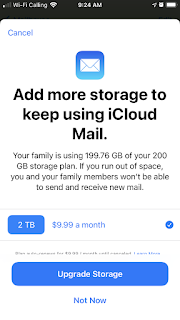
I've run out of iCloud space for my Apple ID. It's not the first time, but this time is one of the worst.
I continually get bombarded now with what amount to advertisements asking for me to either buy more space now or, the other button says, "Not now", implying, "Sure, I'll do this later". There is no, "I realize I'm out of space and I'll handle it on my own danged time, thanks," option. There was a time a week or two ago where, no lie, I was getting notifications about being out of space every 10-15 minutes on my iPhone.
Combine that with all the stupid in-app advertisements for Apple Music any time I want to play a few albums I purchased there and it makes the "Use Edge" pop-ups in Windows look absolutely innocuous.
This badgering is not a mistake. And it's not a technical requirement. It's a marketing strategy.
What I really dislike is that, if the reason for all these annoyance notifications are popping up isn't directly tied to pushing services revenue at Apple (I'd like to think it's not, though it probably is), the fact that these market-driven notifications aren't being called and removed sure is. The culture of the company has shifted primarily to sales and revenue over the last, oh, I don't know, eight years.
Alternatives: Package up half of someone's photos into as many two gig zip files as it takes to get things off of iCloud and into deep storage. Maybe integrate with Dropbox, OneDrive, AWS Glacier, even Backblaze to move the files over so that your day-to-day phone operation can wake back up. And to keep those files in iCloud until you can confirm you have a good copy at the archival service.
Does that make sense? iCloud is, for people who have years and years of pictures, being used in more than one way: Both as active cloud storage for today and as archival storage for years of files. You shouldn't be forced to pay premium dollars for archival storage.Apple doesn't bless us with the distinction, and wants to charge for live storage no matter how often we access something.
The manual Photos clean-up process
Instead, when I run out of space -- essentially always because of photos -- I have to log into iCloud online, as it's got the only good interface for downloading images, select hundreds of pictures, start downloading, hope the download doesn't break, check that the zip works if it does download, then store them on my box while they upload to my preferred cloud service (but could be just making copies on another hard drive), and then tell iCloud.com to delete my images...
... wait for that command to "process", select a few hundred more images, and start again. And again. Until I've take several gigs off and have space in the iCloud again.
But there are certainly other options. iOS could ask if someone can backup their iPhone to a local machine, or back up only the most important parts of your iPhone to iCloud, not every app with every piece of data they care about. Even just an "appless" backup might be useful, especially when all this crap (like your email) is likely already in the cloud. I don't know. But stop asking me to spend $12, no, $36, no $120 each year just to use my phone.
What's a synonym for extortion?
That is, the only solution Apple provides for you when you're out of iCloud space is for you to buy more iCloud space. That's broken. That's the wrong attitude. What is that space being used for? Are there smart ways to do these things another way?
And could we maybe stop shutting down services and bombarding users with notifications until we fork over the cash? Is that you, Mr. Soprano?
The amount of space you get in iCloud is quickly becoming as painful as the iPhone 5c with 8 gigs of local storage. It's a joke, and it's gotta be creating some negative "cust sat" for Mr. Cook. (I'll ignore that Macs still ship with 128 gig hard drives, and those drives are no longer user upgradeable.) Sure, you can say $3 a month for 200 gigs ain't much, but if I have to pay at least that if I'm a "loyal" customer with a long photo history, that's borderline extortion.
The postings on this site are [usually] my own and do not necessarily reflect the views of any employer, past or present, or other entity. About Our Author